
Essential college parent checklist-legal-health-financial forms
As you prepare to send your child off to college, there’s some items many parents miss. Beneath the excitement and dorm shopping is the realization that parenting, as you’ve always known it, is about to change forever. Here you will find essential information about what you need to do before your child goes to college. From bonding questions, health prep, financial and legal logistics and documents (HIPAA, FERPA, POA), see the checklist below.
I’ve been through this, and I’ve talked to enough moms in this stage to know the checklist that really counts has three parts: the relationship, the body, and the paperwork. Here’s what to do before your child leaves for college, in the order I’d actually do it.
As I prepare to send my second son off to college, I am personally going through the following checklist once again. I wanted to share this with you as well.
Key Takeaways
- Before your child leaves for college, prioritize bonding conversations and set expectations for communication.
- Handle health preparation by scheduling checkups, reviewing vaccinations, and discussing mental health resources.
- Get necessary legal documents signed, including HIPAA forms and a durable power of attorney, to ensure access to important information.
- Establish fast money transfer options, set a realistic budget, and confirm insurance coverage for dorm electronics.
- Create an emergency contact list and ensure your child has practical life skills, like laundry and budgeting, before moving in.

What to Do Before Your Child Leaves for College
1. Protect the Bond Before the Distance Does
This is the part nobody puts on a checklist, and it’s the part you’ll remember most in five years.
Have the real conversations now, not in the car on move-in day. The last week before college is chaotic and emotional — not the time to start a heart-to-heart. Carve out low-pressure moments in the weeks before: a drive, a walk, a late-night kitchen chat. Talk about what you’re proud of, what you’re nervous about for them, and what you hope stays the same between you.
Set Expectations In Advance
Set expectations for communication, together. Don’t assume you’ll both want the same thing. Some families do a Sunday phone call; others text daily. Ask your student what feels right to them instead of deciding for them — it respects the independence they’re stepping into and prevents the “why haven’t you called” spiral later.
Make new memories, not just goodbye ones. A final summer trip, a tradition you repeat every year, even just a standing dinner date — these give you something to reference and look forward to, rather than the send-off being the last big thing you did together.
Let them see you handle this well. Kids read their parents closely during transitions. If you’re anxious, it’s okay to name it honestly (“I’m going to miss you too much, and I’m also really excited for you”) rather than either hiding it or leaning on them to manage your emotions.
Write something down. A letter tucked into a suitcase, a note taped inside a drawer, a card they find during finals week. It costs nothing and it’s the kind of thing they keep for years.
Questions to Ask Your Kid Before They Leave for College
If you’re looking for a place to start, skip “are you excited?” and try one of these instead. Save them for a car ride or a quiet night in — not the chaos of move-in day.
- What are you most looking forward to?
- What’s the thing you’re most nervous about?
- How do you want to stay in touch — texting, calling, a weekly time?
- What do you want to make sure doesn’t change between us?
- What do you feel least prepared for — cooking, laundry, managing money?
- Who’s someone you trust to call if you can’t reach me?
- What’s your plan if you’re homesick?
- What’s something about yourself you want to hold onto, no matter who you’re around?
These aren’t interview questions — they’re an invitation. Ask one, then let the conversation go wherever it goes.
2. Handle Health Prep While You’re Still In The Room
This is the boring-but-critical section, and it’s easy to put off until it’s suddenly urgent.
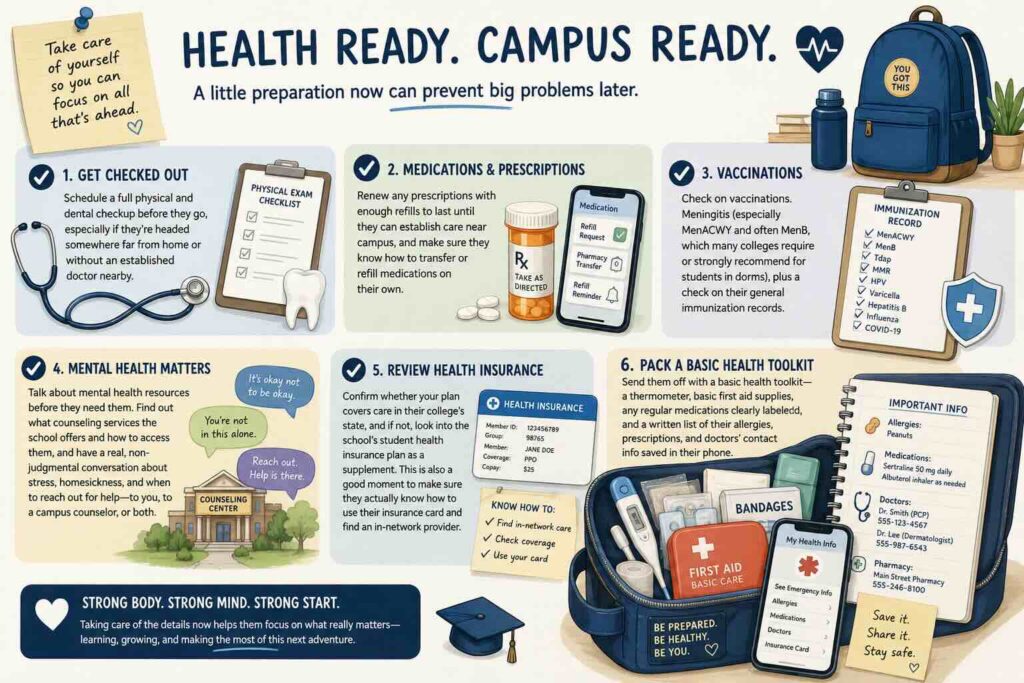
Schedule a full physical and dental checkup before they go, especially if they’re headed somewhere far from home or without an established doctor nearby. Renew any prescriptions with enough refills to last until they can establish care near campus, and make sure they know how to transfer or refill medications on their own.
Check on vaccinations
Meningitis (especially MenACWY and often MenB, which many colleges require or strongly recommend for students in dorms), plus a check on their general immunization records, since many schools require documentation before move-in.
Talk about mental health resources before they need them. Find out what counseling services the school offers and how to access them, and have a real, non-judgmental conversation about stress, homesickness, and when to reach out for help — to you, to a campus counselor, or both.
Review health insurance coverage
Confirm whether your plan covers care in their college’s state, and if not, look into the school’s student health insurance plan as a supplement. This is also a good moment to make sure they actually know how to use their insurance card and find an in-network provider.
Send them off with a basic health toolkit
Put toether a health kit thermometer, basic first aid supplies, any regular medications clearly labeled, and a written list of their allergies, prescriptions, and doctors’ contact info saved in their phone.
3. Get the Legal Documents Signed — This One Surprises Most Parents
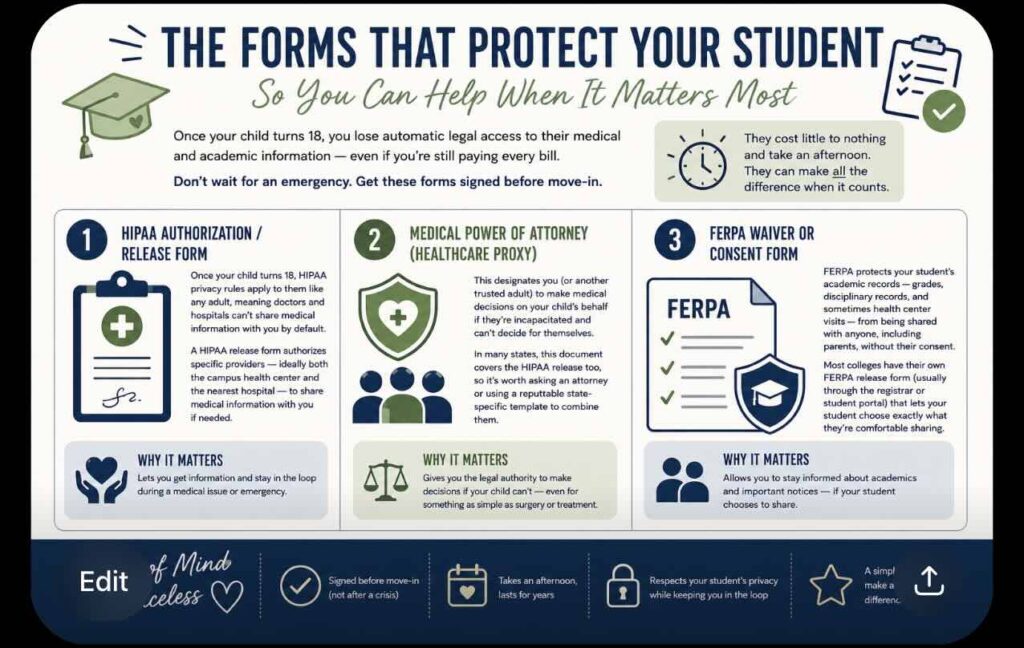
Here’s the part almost no one warns you about: the moment your child turns 18, you lose automatic legal access to their medical and academic information — even if you’re still paying every bill. If there’s an emergency, HIPAA and FERPA can legally block you from getting information or making decisions unless the right paperwork is already in place.
These documents cost little to nothing and take an afternoon, but they need to be signed before move-in, not after a crisis. Keep a digital copy.
HIPAA Authorization/Release Form
Once your child turns 18, HIPAA privacy rules apply to them like any adult, meaning doctors and hospitals can’t share medical information with you by default. A HIPAA release form authorizes specific providers — ideally both the campus health center and the nearest hospital to campus — to share medical information with you if needed.
Medical power of attorney (healthcare proxy)
This designates you (or another trusted adult) to make medical decisions on your child’s behalf if they’re incapacitated and can’t decide for themselves. In many states, this document covers the HIPAA release too, so it’s worth asking an attorney or using a reputable state-specific template to combine them.
FERPA Waiver or Consent Form
FERPA protects your student’s academic records — grades, disciplinary records, and sometimes health center visits — from being shared with anyone, including parents, without their consent.
Most colleges have their own FERPA release form (usually through the registrar or student portal) that lets your student choose exactly what they’re comfortable sharing with you. Have this conversation with your student directly, since it’s their call what gets shared.
Durable Power of Attorney
This lets your child designate you to handle financial or administrative matters — signing a lease, managing a bank account, handling insurance paperwork — if they’re unavailable or unable to do it themselves.
A quick note, and not legal advice: requirements and templates vary by state, so it’s worth a quick conversation with an estate attorney or even a reputable state-bar website to make sure the forms you use are valid where your child will be living and going to school.
Financial Logistics
Set up a way to transfer money fast
At some point, your student is going to need cash quickly — a co-pay, a broken phone screen, a bus ticket home. Figure out the system before you need it, not during a crisis.
A joint bank account gives you the most visibility and control; Venmo or Zelle (don’t attach this to your bank account) is faster and simpler for occasional transfers; a shared budgeting app (like a linked account in Copilot or Honeydue) works well if you want them to see where money’s going, not just receive it. Whatever you choose, test it once before they leave so you’re not troubleshooting an app in the middle of an emergency.
Get them a card for emergencies — and agree on a real budget
A card is the easy part. The harder, more useful conversation is the budget behind it: what’s actually covered (books, food, laundry, going out), what isn’t, and what the plan is if they blow through it in October.
College students don’t usually overspend because they’re irresponsible — they overspend because nobody ever showed them what a realistic month actually costs. Sit down together and rough out real numbers before they go, even if it’s just on the back of a napkin.
Check auto insurance and parking permits
If a car is coming to campus, two things need to happen before move-in, not after: confirming your auto policy still covers them at school (rates and coverage can change based on where the car is garaged most of the year) and registering for a parking permit, since most campuses sell out or require registration well before the semester starts. A car with no permit is a car that gets towed in week one.
Confirm renter’s or property insurance for dorm electronics
Most people assume a laptop or gaming console in a dorm room is automatically covered by somebody’s insurance. It usually isn’t — not fully. Check whether your homeowner’s or renter’s policy extends to a student living away from home (many do, up to a limit), or whether it’s worth adding a cheap rider or a separate renter’s policy for the room. This is a five-minute phone call that saves an expensive replacement if there’s a theft or a flood down the hall.
Update their mailing address
Anything tied to their name — bank statements, subscriptions, prescriptions, their driver’s license renewal — needs a plan for where mail actually goes. Decide together whether that’s a campus mailbox, a PO box, or still your home address with a forwarding plan, and get it updated before the first bill or package goes to the wrong place.

Emergency Contacts Every College Student Should Have Before Move-In
If your child needed help tonight, would they know who to call?
Most incoming freshmen leave home with hundreds of contacts in their phones—but very few have the right ones saved where they can find them quickly during an emergency.
Take 15 minutes before move-in to create an emergency contact list together.
📱 Save These Numbers in Their Phone
Parents or Guardians
Include:
- Cell phone numbers
- Work numbers (if applicable)
- A backup number in case one parent is unavailable
A Trusted Local Relative or Family Friend
Choose someone who:
- Lives within a reasonable driving distance
- Could pick them up if necessary
- Could help in an emergency if you can’t get there quickly
Practical Life Skills (Yes, Really)
Do a full trial run of laundry
Not a tutorial — an actual, hands-off trial run where they do a full load start to finish while you watch and only step in if something’s about to go wrong. Include the stuff that trips people up: reading a care label, treating a stain before it sets, not shrinking the one sweater they actually like, and knowing what happens if they leave a red shirt in with the white towels. This is a ten-minute lesson that prevents a semester of “everything’s kind of gray now.”
Academic & Administrative
- Check the returned-item and financial aid refund timeline so there are no surprises with billing.
- Confirm class registration, orientation dates, and any required placement tests or forms.
- Set up (or confirm access to) the student portal, campus email, and learning management system (Canvas, Blackboard, etc.).
- Look into on-campus tutoring, writing centers, and academic advising — better to know before it’s needed.
Practice a real monthly budget — and what happens if they go over
The Real Send-Off Checklist
If you take one thing from this: the mini fridge matters a lot less than the conversation, the doctor’s visit, and the folder of signed documents sitting in your student’s backpack. Handle those three things now, while you still have them at the kitchen table, and the rest of the college send-off gets a whole lot easier.
Frequently Asked Questions
What legal documents does my child need before turning 18 and leaving for college?
At minimum: a HIPAA release form, a medical power of attorney (healthcare proxy), a FERPA waiver through their school, and a durable power of attorney for financial matters. Requirements vary by state, so it’s worth a quick check with an estate attorney or your state bar’s website.
Can I still access my college student’s medical records once they turn 18?
Not automatically. Once your child turns 18, HIPAA treats them as an adult, so doctors and hospitals can’t share their medical information with you unless a signed HIPAA release form is on file.
What vaccines does my child need before starting college?
Most colleges require or strongly recommend the meningococcal vaccine (MenACWY, and often MenB) for students living in dorms, plus standard childhood immunizations. Check your specific school’s requirements before move-in.
When should I start having “before college” conversations with my child?
In the weeks before move-in, not the final days. Emotions run high right before drop-off, so low-pressure moments — a drive, a walk, a quiet evening — work better than trying to fit everything into the last week.
What would you add to this list? I’d love to hear what helped your family in the comments below.