
Essential lab blood tests for women over 40-60
Here’s a scene I bet you know. You’re sitting in the exam room in that paper gown, your doctor asks “any concerns?” and your mind goes completely blank. The appointment ends, you get a referral for a mammogram, and you walk out wondering: was that it? Did I get everything I needed? We share a complete guide to the lab tests for women at 40, 50, and 60.
Sis, same. The 15-minute annual visit was never designed to be proactive. It’s reactive — you show up with a problem, they address it. But if you want to get ahead of your health? You have to come in knowing what to ask for in a comprehensive lab panel.
Download the printable guide by clicking here.
That’s exactly what this guide is. A decade-by-decade cheat sheet of the most important labs to request at 40, 50, and 60 — the ones that give you a real picture of what’s going on inside your body, so you can catch things early, course-correct, and keep living your most vibrant life. Lab tests can be an ideal health screening.
Print this out. Screenshot it. Text it to your sister. This is the conversation your doctor doesn’t always have time to start — but you can.
Key Takeaways
- Annual blood work (health screenings) is not enough. Most standard panels miss critical markers for women’s health — you need to know what to ask for.
- Your 40s are about catching the early signs of hormonal shifts, thyroid issues, blood sugar changes, and cardiovascular risk.
- Your 50s are about menopause and heart health — two things that become deeply connected once estrogen declines.
- Your 60s are about longevity protection — bone density, kidney function, cancer screening, and keeping cardiovascular risk in check.
- You are your own best advocate. A great doctor will welcome these questions. And if yours doesn’t? That’s information too.

Why Women Over 40 Need Different Lab Panels Than Men
Here’s something that doesn’t get talked about enough: for most of medical history, clinical studies were conducted primarily on men. The “standard” reference ranges for many tests were built on male data. And yet women’s bodies — especially after 40 — operate very differently.
Fluctuating and declining estrogen affects everything: your cholesterol levels, your thyroid function, your blood sugar regulation, your bone density, your heart. What looks “normal” on a standard panel can actually be an early warning sign for a woman in perimenopause or postmenopause — if you’re looking at the right markers.
The labs below are the ones that give you a fuller, more accurate picture of your health as a woman navigating each decade. Let’s dig in.
Related Content Links:
IN YOUR 40S: Lay Your Foundation & Catch the Early Signs
Your 40s are when things start to quietly shift. Estrogen begins its gradual (and sometimes not-so-gradual) fluctuation. Thyroid issues peak. Blood sugar can creep up. Cholesterol changes. None of it has to become a problem — but only if you catch it early.
Essential Blood Tests Every Woman Should Ask For in Her 40s
Comprehensive lab panel guide:
Blood Tests Every Woman in Her 40s Should Ask About
Focus: heart disease risk, blood sugar, thyroid, and iron/energy levels as periods often become irregular.
| Test | What It Tests | Why It’s Important |
|---|---|---|
| CBC (Complete Blood Count) | Red blood cells, white blood cells, hemoglobin, and platelets | Screens for anemia, infection, and overall blood health |
| CMP (Comprehensive Metabolic Panel) | Liver enzymes, kidney function, blood sugar, and electrolytes | Flags early liver, kidney, or metabolic issues before symptoms appear |
| Lipid Panel | Total cholesterol, LDL, HDL, and triglycerides | Baseline for heart disease risk, which begins climbing in your 40s |
| HbA1c | Average blood sugar over the past 2-3 months | Catches prediabetes and diabetes; the American Diabetes Association now recommends screening starting at 35 |
| TSH | Thyroid-stimulating hormone | Thyroid disorders are common in women and often mistaken for normal aging or stress |
| Vitamin D | Vitamin D stores in the blood | Supports bone density, immunity, and mood; deficiency is extremely common |
| Lp(a) — Lipoprotein(a)Often skipped | A genetic, inherited particle that raises heart disease risk | 2026 cardiology guidelines now recommend every adult be tested once in their lifetime — most doctors don’t order it unless asked |
| Fasting InsulinOften skipped | How much insulin your body needs to keep blood sugar normal | Can reveal insulin resistance up to a decade before HbA1c or glucose become abnormal |
| Ferritin & Iron PanelOften skipped | Stored iron, serum iron, and iron-binding capacity | A standard CBC can miss early iron deficiency; ferritin drops years before hemoglobin does — important while still menstruating |
| Free T3 & Free T4Often skipped | Active thyroid hormone levels | TSH alone can miss thyroid problems; a full panel gives a more complete picture |
💚 Gal Pal Tip
Don’t simply ask whether your results are “normal.” Request a copy of your lab report and review your actual numbers with your healthcare provider. Tracking changes over time can be more informative than looking at a single test result.
⭐ Consider Adding These Based on Your Symptoms
| Additional Test | Why It Matters |
|---|---|
| Hormone Panel (FSH, Estradiol, Progesterone) | Helps determine if you’re entering perimenopause and explains symptoms like hot flashes, mood swings, irregular periods, and sleep disturbances. |
| hsCRP | Measures chronic inflammation, an important risk factor for heart disease, stroke, diabetes, and some cancers. |
| Fasting Insulin | Can detect insulin resistance years before blood sugar or A1c become abnormal. |
| DHEA-S & Cortisol | Evaluates adrenal health and may help explain chronic fatigue, burnout, and prolonged stress. |
| Vitamin B12 | Essential for healthy nerves, brain function, and energy production. Deficiency becomes more common with age and in those taking metformin or acid-reducing medications. |
💚 Gal Pal Tip: Don’t just ask if your blood work is “normal.” Ask for your actual numbers and keep a copy each year. Watching trends over time is often more valuable than a single result. Many health changes begin gradually, and catching those shifts early gives you the opportunity to make lifestyle changes before they become bigger problems.
IN YOUR 50S: Menopause, Your Heart, and Protecting Your Bones
Your 50s bring one of the most significant hormonal transitions of your life — menopause. And with it comes a shift in your health risk profile that is real and important to understand. The good news? Women who know what’s changing can take powerful steps to protect themselves. Here’s what to be tracking.
Everything in the 40s section still applies. Your annual bloodwork should continue with all the same markers. But in your 50s, these additions become especially important:

Essential Health Tests Every Woman Should Ask For in Her 50s
Continue the important blood tests from your 40s, while paying closer attention to heart health, bone strength, blood sugar, and menopause-related changes.
Blood Tests Every Woman in Her 50s Should Ask About
Focus: heart health, bone density, inflammation, and brain health through the menopause transition.
| Test | What It Tests | Why It’s Important |
|---|---|---|
| CBC | Red blood cells, white blood cells, hemoglobin, and platelets | General health screening and anemia check |
| CMP | Liver, kidney, blood sugar, and electrolyte function | Monitors organ function as metabolism shifts with menopause |
| Lipid Panel | Total cholesterol, LDL, HDL, and triglycerides | Cardiovascular risk rises sharply after menopause as estrogen drops |
| HbA1c | Average blood sugar over 2-3 months | Diabetes risk increases in this decade |
| TSH | Thyroid-stimulating hormone | Thyroid disease risk continues to rise with age |
| Vitamin D & Calcium | Vitamin D stores and calcium levels | Bone loss accelerates after menopause; both are essential for bone protection |
| Vitamin B12 | B12 stores in the blood | Supports energy and nerve health; absorption often declines with age |
| ApoBOften skipped | The number of artery-clogging particles in the blood | Considered a more precise heart disease risk marker than LDL alone |
| hs-CRPOften skipped | A sensitive marker of inflammation in the body | Chronic inflammation is an independent risk factor for heart disease |
| HomocysteineOften skipped | An amino acid linked to cardiovascular and brain health | Elevated levels are tied to heart disease and cognitive decline, and are easily corrected with B-vitamins |
| MagnesiumOften skipped | Magnesium levels in the blood | Supports bone density, muscle function, sleep, and healthy heart rhythm |
| TPO AntibodiesOften skipped | Antibodies that attack the thyroid | Can detect autoimmune thyroid disease (Hashimoto’s) even when TSH looks normal |
💡 Gal Pal Tip: If you haven’t already, ask about a calcium score (coronary artery calcium scan) in your 50s. It’s a low-dose CT scan that detects calcium buildup in your arteries — one of the best predictors of future heart events. Not a blood test, but absolutely worth asking your cardiologist about.
💛 IN YOUR 60S: Play Defense, Protect Your Future, Live Fully
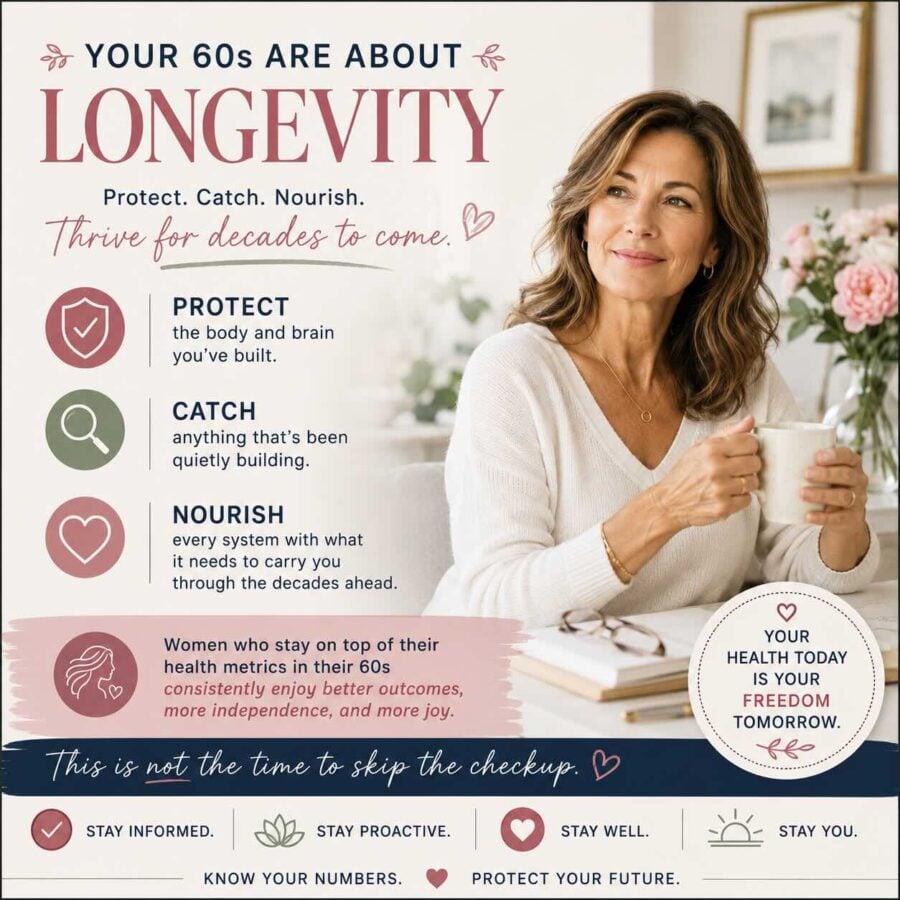
Your 60s are about longevity — protecting the body and brain you’ve built, catching anything that’s been quietly building, and making sure every system has what it needs to carry you through the decades ahead.
Women who stay on top of their health metrics in their 60s consistently enjoy better outcomes, more independence, and more joy. This is not the time to skip the checkup.
Essential Health Tests Every Woman Should Ask For in Her 60s
Your 60s are about protecting your strength, independence, heart, bones, brain, and long-term health. Continue the appropriate testing from your 40s and 50s while watching for changes over time.
Blood Tests Every Woman in Her 60s+ Should Ask About
Focus: heart health, brain health, bone strength, and healthy aging.
| Test | What It Tests | Why It’s Important |
|---|---|---|
| CBC | Red blood cells, white blood cells, hemoglobin, and platelets | General health and anemia screening |
| CMP (including eGFR) | Liver, kidney function, blood sugar, and electrolytes | Kidney function becomes increasingly important to monitor with age |
| Lipid Panel | Total cholesterol, LDL, HDL, and triglycerides | Ongoing heart disease risk monitoring |
| HbA1c | Average blood sugar over 2-3 months | Diabetes screening |
| TSH | Thyroid-stimulating hormone | Thyroid function monitoring |
| Vitamin D & B12 | Vitamin D and B12 stores | Support bone strength, muscle, and brain and nerve health |
| ApoBOften skipped | The number of artery-clogging particles in the blood | More precise cardiovascular risk marker than standard cholesterol numbers |
| hs-CRPOften skipped | A sensitive marker of inflammation | Ongoing cardiovascular risk indicator |
| Magnesium & Uric AcidOften skipped | Mineral and metabolic waste levels in the blood | Support muscle, heart rhythm, joint, and metabolic health |
| Urine Microalbumin (ACR)Often skipped | Small amounts of protein in the urine | An early warning sign of kidney and blood vessel changes, often missed by blood tests alone |
| Lp(a)If never tested | A genetic, inherited heart disease risk particle | Only needs to be tested once in a lifetime — worth asking for if it’s never been done |
Cancer Screenings to Keep Up With in Your 60s
These aren’t blood tests, but they’re just as essential:
- Mammogram: Every 1–2 years — continue through your 70s if you’re in good health.
- Colorectal cancer screening: Colonoscopy every 10 years (or stool DNA test every 3 years). If you haven’t done one yet — this is the decade to stop putting it off.
- Pap smear / HPV test: Still recommended through age 65. If all prior results were normal, you may be able to stop after 65 — discuss with your doctor.
- Skin cancer check: Annual full-body skin exam with a dermatologist. Melanoma risk increases with age.
- Eye exam: Annually for glaucoma, macular degeneration, and cataracts.
💡 Gal Pal Tip: Bring a summary of your last 2–3 years of labs to every appointment. Trends matter more than single data points. If your A1c has crept from 5.4 to 5.7 over three years, that’s meaningful — even if both numbers are technically “normal.”
How to Ask for These Tests
Here’s the truth: some doctors will order everything you ask for. Others will push back with “your insurance won’t cover that” or “that’s not standard protocol.” Neither response means you stop advocating for yourself.
A few scripts that work:
- “I’d like to be more proactive about my health this decade.” Then hand them this list.
- “I’ve been reading about [ApoB / hsCRP / Vitamin D] and I’d like to get a baseline.” Most doctors respect research-informed patients.
- “I have a family history of [heart disease / osteoporosis / diabetes] and I want to track these markers proactively.” Family history is a golden ticket for getting tests approved.
- “Can you order a comprehensive panel, including thyroid function and Vitamin D?” Specific language helps.
And if your doctor consistently dismisses your concerns or makes you feel like a burden for asking questions? You are not obligated to stay. Finding a physician who sees you as a partner in your own health — not an inconvenience — is one of the best investments you can make.
Your Gal Pal Lab Cheat Sheet at a Glance
Screenshot this for your next appointment:
| Lab Test | In Your 40s | In Your 50s | In Your 60s |
| CBC | ✓ | ✓ | ✓ |
| Comprehensive Metabolic Panel | ✓ | ✓ | ✓ |
| Lipid Panel | ✓ | ✓ | ✓ |
| Fasting Glucose + HbA1c | ✓ | ✓ | ✓ |
| Thyroid (TSH + T3 + T4) | ✓ | ✓ | ✓ |
| Vitamin D | ✓ | ✓ | ✓ |
| Ferritin | ✓ | ✓ | ✓ |
| hsCRP | Ask | ✓ | ✓ |
| Fasting Insulin | Ask | ✓ | ✓ |
| ApoB | — | ✓ | ✓ |
| Hormone Panel | If symptoms | ✓ | As needed |
| DEXA Scan | — | ✓ at menopause | ✓ every 1–2 yrs |
| Homocysteine | — | Baseline | ✓ |
| eGFR (Kidney) | In CMP | In CMP | Monitor trend |
| Cognitive Screen | — | — | Ask |
| Mammogram | ✓ | ✓ | ✓ |
| Colorectal screening | — | ✓ | ✓ |
The Bottom Line: Your Body Is Worth Knowing
Here’s what I want you to walk away with: your annual physical is the beginning of the conversation, not the whole thing. The more you know about what’s happening in your body — the real numbers, the trends, the markers that matter — the more power you have to shape what comes next.
You’ve been showing up for everyone else for decades. It is absolutely your turn to show up for yourself — starting with one appointment where you walk in with a list and walk out with real answers.
Which lab on this list are you asking for at your next appointment? Drop it in the comments — and share this with a Gal Pal who needs it! 💕
Disclaimer: This post is for informational and educational purposes only and is not a substitute for professional medical advice. Always work with your own healthcare provider to determine which tests are right for you based on your personal health.