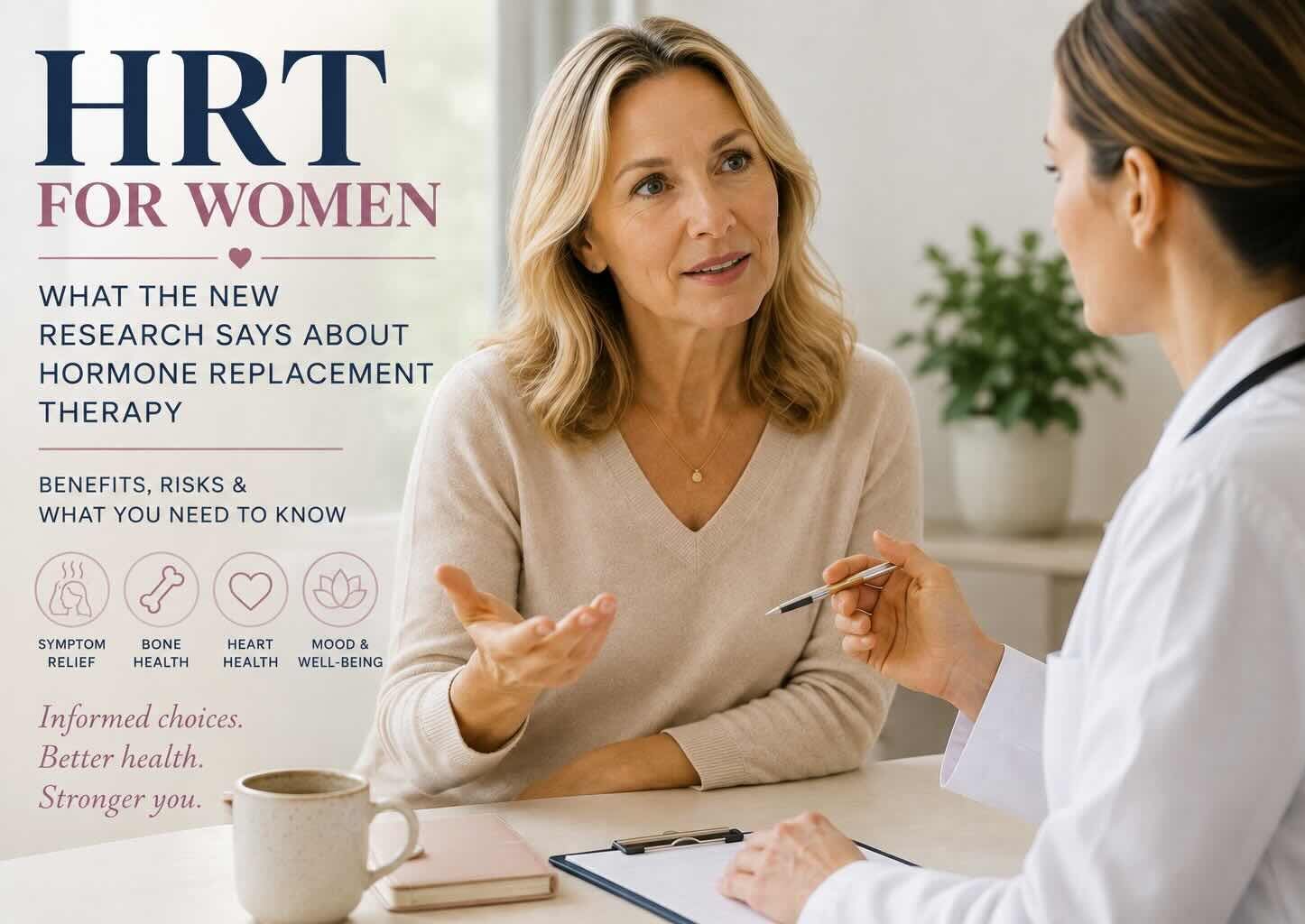
HRT for Women: New Hormone Replacement Therapy Research
Here’s a conversation I’ve had with at least six friends in the last year. It starts with someone whispering, “Are you still fighting through night sweats?” and ends forty-five minutes later with all of us comparing notes on hormone therapy like we’re trading stock tips. Half of us were told by a doctor a decade ago that HRT was dangerous. The FDA just removed the HRT’s biggest warning labels. Learn what the research shows and what to do next.
So if you are going through menopause, you need to read this.
Key Takeaways
Key Takeaways
- The FDA updated hormone replacement therapy labels in 2026, removing overblown risks related to breast cancer and heart disease.
- Starting hormone replacement therapy after 40 can provide significant benefits, especially when begun within 10 years of menopause onset.
- Recent studies 2026- show HRT can reduce dementia risk and lower the chance of osteoporosis-related fractures.
- Women need to discuss HRT with their doctors, focusing on individual health history and updated guidelines.
- HRT can improve various menopause symptoms, including hot flashes, sleep quality, and bone health, benefiting many women over 40.
In This Post
- Why HRT Suddenly Back in the News
- What Actually Changed on the Label of HRT?
- What the Research Says About Timing
- Who Tends to Benefit Most from HRT?
- What This Doesn’t Mean
- How to Bring This Up With Your Doctor
Why This Is Suddenly Back in the News
If you’re 40-something or older, you probably grew up on the same headline I did: an early-2000s study linked hormone therapy to breast cancer and heart disease. An entire generation of women and their doctors quietly filed HRT under “too risky, don’t ask.” For twenty years, that fear shaped how menopause was treated, or more accurately, how often it wasn’t treated at all.
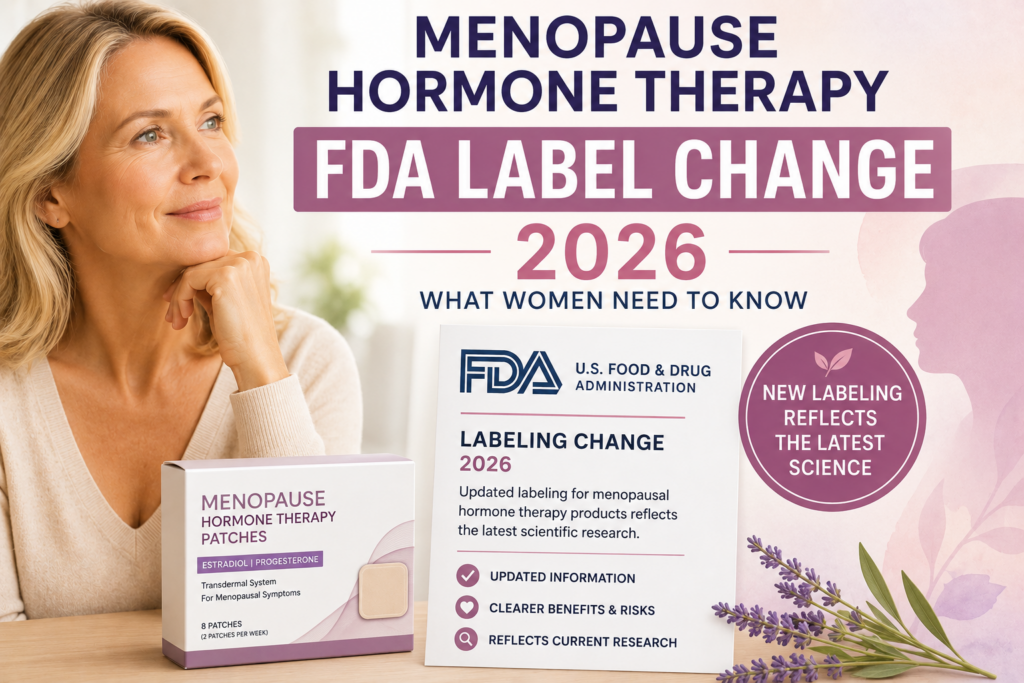
In November 2025, the FDA began walking that back. After a comprehensive review of the scientific literature, the agency requested that drug manufacturers submit updated labeling. On February 12, 2026, it approved those changes for the first six products, covering every major category of hormone therapy — combination estrogen-progestogen, estrogen-alone, progestogen-alone, and topical vaginal estrogen.
HHS Secretary Robert F. Kennedy Jr. put it plainly in the FDA’s announcement: the goal was to make sure “women receive accurate information about hormone therapy — free from exaggeration or fear.” FDA Commissioner Dr. Marty Makary added that the update reflects the “potentially life-changing benefits of HRT” for women dealing with menopause symptoms that can last for years.
What Actually Changed on the Label
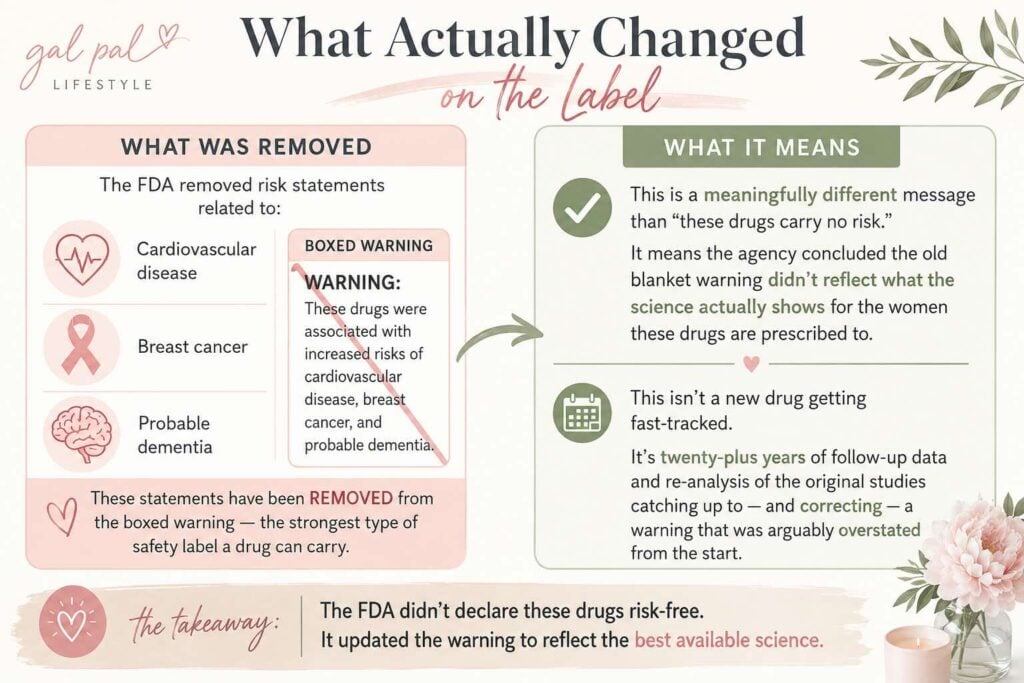
Specifically, the FDA removed risk statements related to cardiovascular disease, breast cancer, and probable dementia from the boxed warning — the strongest type of safety label a drug can carry, reserved for the most serious known risks. That’s a meaningfully different message than “these drugs carry no risk.” It means the agency concluded the old blanket warning didn’t reflect what the science actually shows for the women these drugs are prescribed to.
This isn’t a new drug getting fast-tracked. It’s twenty-plus years of follow-up data and re-analysis of the original studies catching up to and correcting a warning that was arguably overstated from the start.
“Women don’t have to suffer. There are solutions out there and doing nothing doesn’t have to be the answer.”
— Stephanie Faubion, MD, MBA, Mayo ClinicDr. Faubion also makes the healthy-aging connection particularly well: menopause management can help women preserve quality of life, while healthy lifestyle habits help “set women up for healthy aging.”
What the Research Says About Age and Timing
The detail that matters most for anyone in their late 30s, 40s, or early 50s is this: the benefit-risk picture changes depending on when you start.
According to the FDA’s own summary of the evidence, women who begin hormone therapy within 10 years of the onset of menopause generally before age 60 show a reduction in all-cause mortality and in fractures from osteoporosis.
Newer research also separates younger, early-postmenopausal women from older groups more precisely than older studies did, and in the right candidates, overall cardiovascular risk doesn’t rise significantly, and some women see improvements in blood pressure and cholesterol.
This is sometimes called the “timing hypothesis” in menopause research: hormone therapy started closer to menopause behaves differently in the body than therapy started a decade or two later. It’s part of why the old one-size-fits-all warning didn’t hold up.
If you’ve already had your labs done (and if you haven’t, here’s what to ask your doctor to check), this is exactly the kind of conversation those numbers should feed into.
Dr. Sandra Rice’s Book: The Estrogen Question
Dr. Sandra Rice was my mother’s Dr. for many years. My mom is grateful Dr. Rice supported her decision to pursue HRT.
She says she wrote The Estrogen Question: Know Before You Say “No” to HRT because she saw too many women struggling to get clear, scientifically based information about menopause and hormone therapy. After more than three decades practicing internal medicine and caring for thousands of women, she became concerned that both patients and some healthcare providers were making decisions about HRT based on outdated or misunderstood information.
New Research 2026- Estrogen and Dementia Connection
What the newest research found
A major 2026 study followed 183,450 postmenopausal women for about 13 years. Compared with women who never used HRT, women who had used HRT had approximately:
- 10% lower risk of developing dementia overall
- 16% lower risk of developing Alzheimer’s disease
- 26% lower dementia risk among women who experienced surgical menopause
- Potentially greater benefit among women with lower lifetime estrogen exposure and women carrying the APOE ε4 genetic variant, an important genetic risk factor for Alzheimer’s.
One particularly interesting finding was timing: the strongest association with lower dementia risk appeared among women who began HRT roughly between ages 46 and 56.
And another new study looked at actual Alzheimer’s changes in the brain
Researchers examined autopsy and medical data and found that women who had used estrogen-only menopausal hormone therapy had about 35% lower odds of having Alzheimer’s-related brain pathology than women who had not used it.
That’s intriguing because it goes beyond simply asking whether someone received a dementia diagnosis—it looks at the characteristic changes associated with Alzheimer’s in the brain.
HRT + Bone Health
34% LOWER RISK OF HIP FRACTURE
In a combined analysis of 25,389 postmenopausal women in the Women’s Health Initiative randomized hormone-therapy trials, menopausal hormone therapy was associated with:
- 34% lower risk of hip fracture
- 40% lower risk of major osteoporotic fracture
- 28% lower risk of any clinical fracture
Read the Women’s Health Initiative research on PubMed
Who Tends to Benefit Most From HRT?
Hormone therapy is FDA-approved for:
- Moderate-to-severe hot flashes and night sweats (vasomotor symptoms)
- Vaginal dryness, discomfort, and urinary tract changes caused by declining estrogen
- Preventing bone loss and reducing osteoporosis-related fracture risk
If you’re dealing with any of these and have been told to just “push through it,” this new labeling is a legitimate reason to revisit that conversation.
What’s striking is the gap between who could benefit and who’s actually being treated. Around 41 million American women are between 45 and 64. This is the age range where these symptoms are most common .
Historically only about 2 million women in that range have received an HRT prescription in a given year. That’s not because the other 39 million didn’t need help. It’s largely because two decades of overstated warnings made both women and doctors hesitant to even discuss it.
HRT Benefits: By the Numbers
- 75% fewer hot flashes — HRT is the most effective treatment for hot flashes and night sweats.
- Up to 87% less severe hot flashes — Significant relief for many symptomatic women.
- Better sleep — Especially when night sweats and hot flashes are causing wake-ups.
- 40% fewer major osteoporotic fractures — HRT helps preserve bone strength.
- 34% fewer hip fractures — A major benefit as fracture risk increases with age.
- 28% fewer fractures overall — Found in Women’s Health Initiative research.
- Higher bone density — HRT helps slow the rapid bone loss associated with menopause.
- Less vaginal dryness — Estrogen helps restore vaginal tissue and moisture.
- Less painful sex — Estrogen therapy can improve menopause-related vaginal discomfort.
- Improved urinary symptoms — Vaginal estrogen can help some urinary symptoms associated with menopause.
- Improved quality of life — Treating disruptive menopause symptoms can improve day-to-day well-being.
The takeaway: HRT isn’t just about hot flashes. For appropriately selected women, it can help with sleep, bones, vaginal and sexual health, urinary symptoms, eye health and overall menopause symptom relief.
What This Doesn’t Mean
It’s not a declaration that HRT is 100% risk-free. Every hormone therapy may still carry risks and isn’t right for every woman — your personal and family health history, the specific product, dose, and how it’s delivered (pill vs. patch vs. topical) all matter.
It’s not a one-size-fits-all recommendation. “Right candidates” is doing real work in that sentence. This is a conversation for you and your doctor, not a decision to make from a blog post — mine included. Many women also should consider natural remedies for hot flashes.
It’s not permission to skip the workup. If anything, this is a better reason to get real bloodwork and a real conversation with a doctor who’s current on the 2026 guidance, rather than relying on what you were told in 2010.
How to Bring This Up With Your Doctor
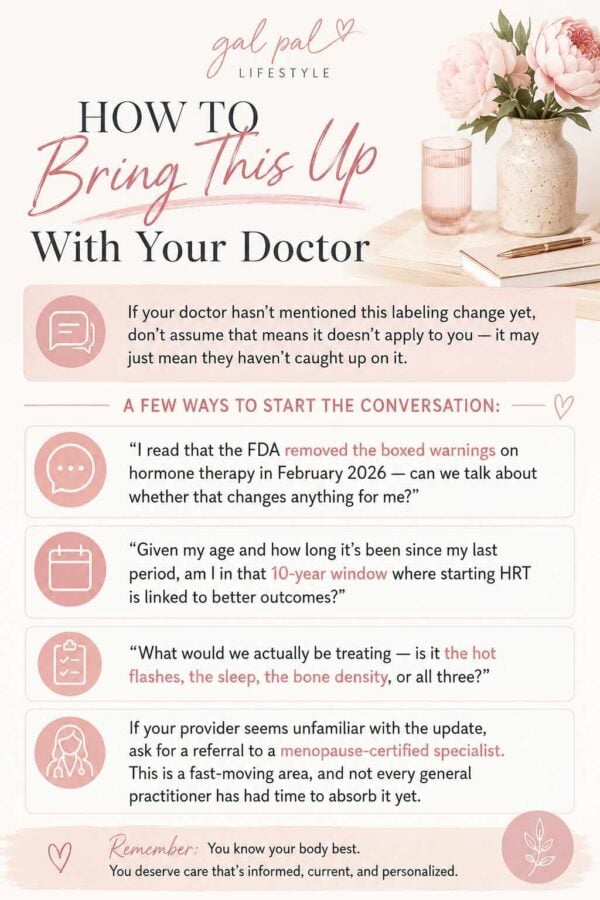
If your doctor hasn’t mentioned this labeling change yet, don’t assume that means it doesn’t apply to you — it may just mean they haven’t caught up on it. A few ways to start the conversation:
- “I read that the FDA removed the boxed warnings on hormone therapy in February 2026 — can we talk about whether that changes anything for me?”
- “Given my age and how long it’s been since my last period, am I in that 10-year window where starting HRT is linked to better outcomes?”
- “What would we actually be treating — is it the hot flashes, the sleep, the bone density, or all three?”
- If your provider seems unfamiliar with the update, ask for a referral to a menopause-certified specialist. This is a fast-moving area, and not every general practitioner has had time to absorb it yet.
This is one of those moments where being your own advocate matters. For years, the fear around hormone therapy wasn’t really about you — it was about an outdated label. That label just changed. What you do with that information is still entirely yours to decide, ideally with a doctor who’s read the same update you have.
This post is for informational purposes and reflects publicly available FDA guidance as of February 2026. It isn’t medical advice — please talk to your own doctor about what’s right for your health history.
Sources
FDA: FDA Approves Labeling Changes to Menopausal Hormone Therapy Products (Feb. 12, 2026)
FDA: Menopausal Hormone Therapies with Updated Prescribing Information