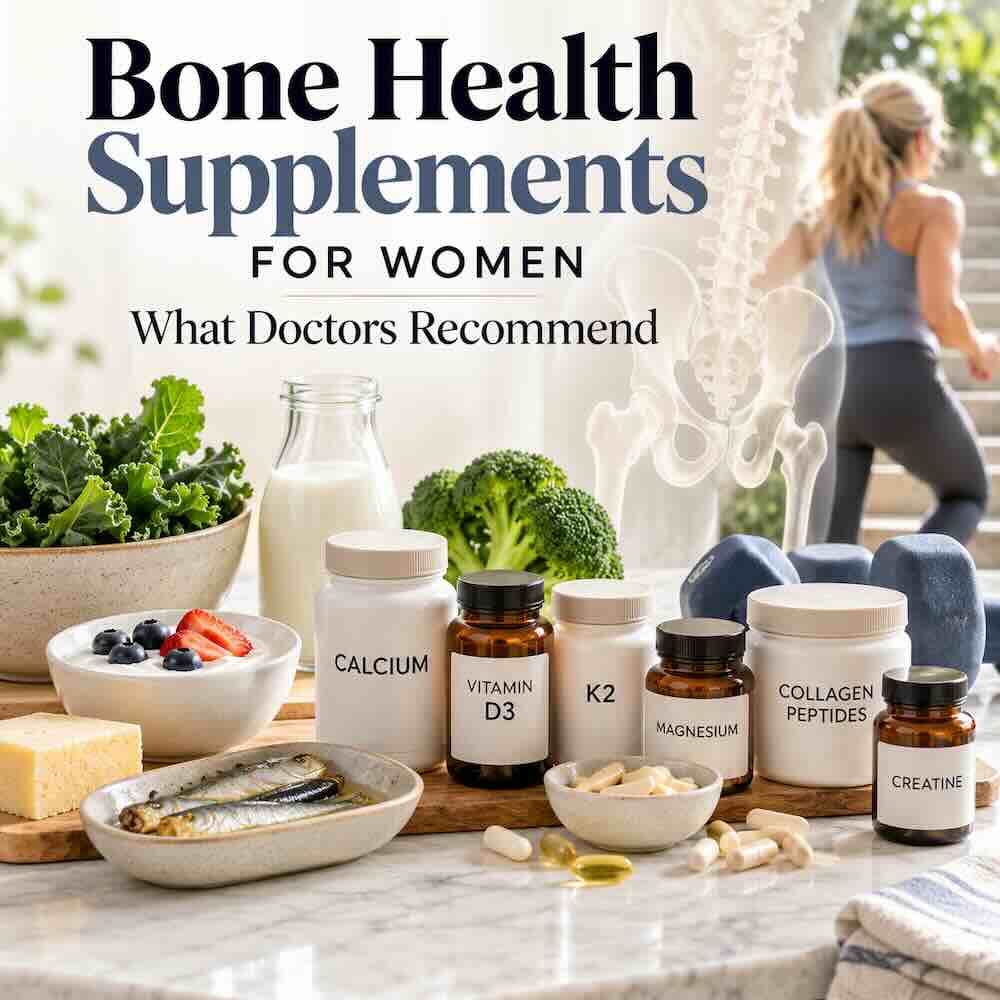
Best Bone Health Supplements for Women: What Doctors Say
Keeping our bones healthy and strong is one of the biggest health concerns women have as we get older. The Bone Health & Osteoporosis Foundation reports that “approximately one in two women over age 50 will break a bone because of osteoporosis, and that “a woman can lose up to 20% of her bone density following menopause. In this post discover the best supplements for bone density for women, sorted by what doctors and research support.
And don’t forget movement! As I shared in my recent article on the best exercises for bone density, Calcium helps provide the building blocks, while exercises such as strength training, jumping, stomping, and stair climbing give your bones the mechanical stimulus they need to adapt and stay strong.
Think of it this way: feed your bones—and challenge them, too.
I wanted real answers, so I audited my own supplement shelf against the research. I read what the studies and the doctors’ organizations say about the best supplements for bone density, from a calcium supplement for women over 50 to vitamin D3 and K2, collagen, and magnesium.
Key Takeaways
- Women over 50 face significant bone health concerns, with one in two at risk of osteoporosis-related fractures.
- Key bone health supplements for women include calcium, vitamin D3, vitamin K2, magnesium, and collagen, though more isn’t always better.
- It’s essential to prioritize food sources for calcium and use supplements only to fill dietary gaps.
- Doctors recommend a holistic approach: focus on exercise and nutrition alongside supplements for optimal bone health.
- Consider reputable third-party testing for supplements, ensuring quality and safety before including them in your regimen.
My Supplement Cabinet Needed an Intervention
Women are bombarded with information about supplements as we get older. One promises stronger bones. Another promises stronger muscles. Another is supposedly going to help our skin, hair, sleep, energy and maybe turn back the clock while it’s at it.
Before long, we’re swallowing a handful of pills and powders without really knowing which supplements we actually need—or why we’re taking them. Can you relate?
Last week, I posted about the best exercises for stronger bones . After researching the best exercises for bone density, I wanted to tackle the other side of the equation: health supplements for stronger bones.
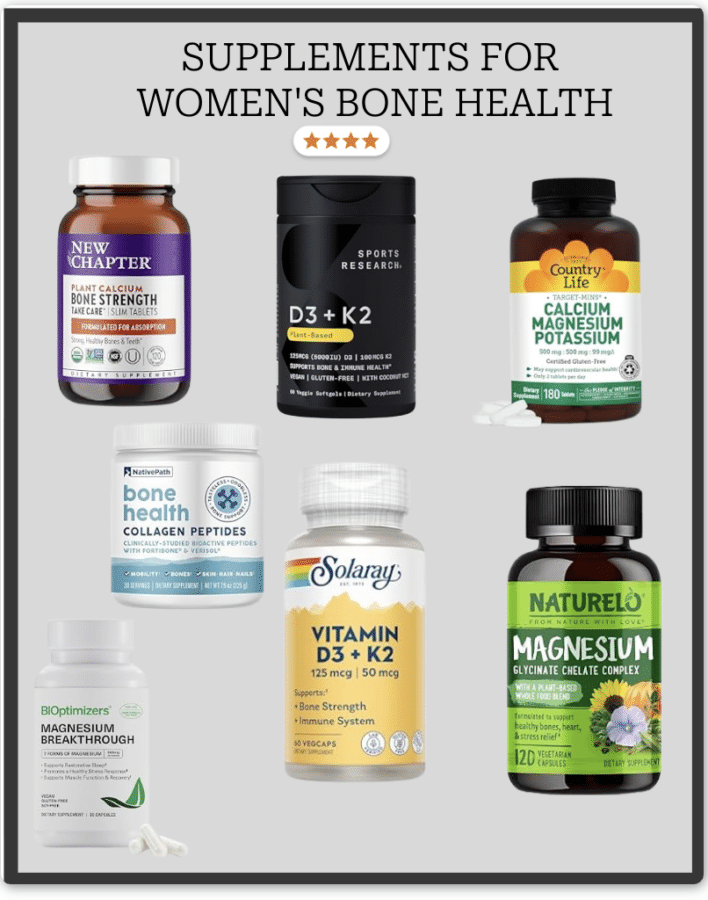
What are the best bone health supplements for women?
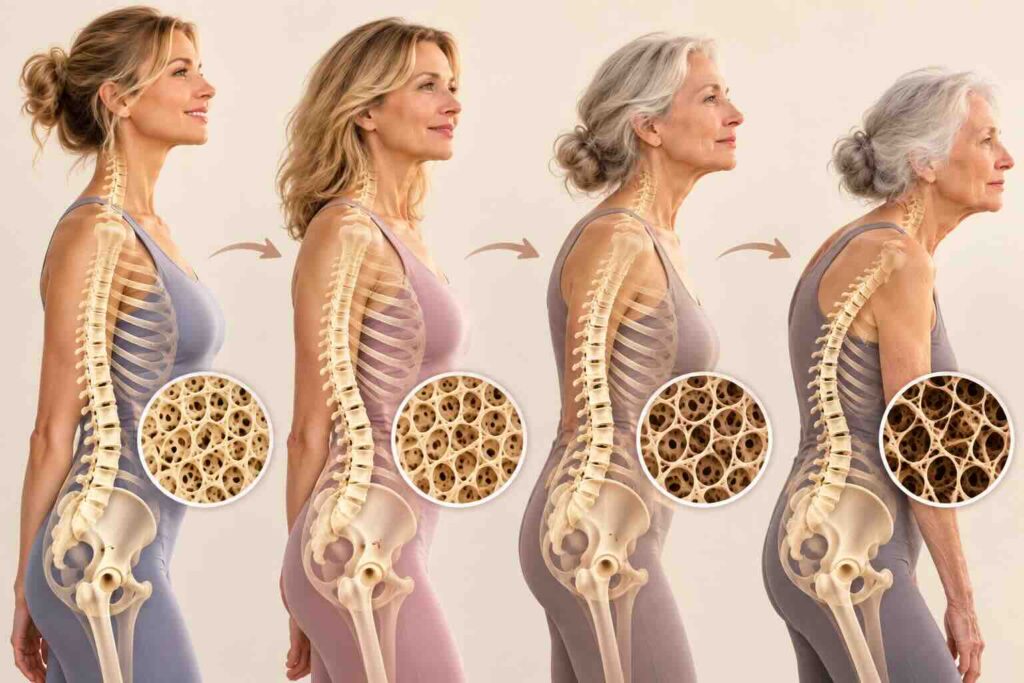
That’s an important question because approximately one in two women over age 50 will break a bone because of osteoporosis, and women can lose a significant amount of bone density during the years surrounding menopause.
Even more concerning? Bone loss is silent. We don’t feel it happening.
So I decided to give my supplement shelf a little audit.
I dug into the research on calcium, vitamin D3, vitamin K2, magnesium, collagen and creatine for women to figure out what has good evidence behind it, what looks promising and what doctors don’t routinely recommend.
And spoiler alert: More supplements don’t necessarily mean stronger bones.
Best Supplements for Bone Density: The Quick List
Here’s the cheat sheet before we dig into the details.
- Calcium: Important if you aren’t getting enough through food. Women 51+ generally need 1,200 mg per day from food and supplements combined.
- Vitamin D3: Important for calcium absorption and bone health, but more isn’t necessarily better.
- Vitamin K2: Interesting and promising research, particularly MK-7, but not yet routinely recommended for osteoporosis prevention.
- Magnesium: Essential nutrient, but routine supplementation specifically for bone density isn’t recommended for most healthy women.
- Collagen peptides: Promising early research, particularly specific collagen peptides studied in postmenopausal women.
- Creatine monohydrate: Much stronger evidence for maintaining muscle and strength than for directly improving bone density.
- Strontium and herbal bone blends: Not routinely recommended for osteoporosis prevention.
The Most Important Lesson
Food first. Supplements fill gaps.
The Bone Health & Osteoporosis Foundation recommends getting calcium primarily from food and using a supplement only when necessary to reach your daily requirement. That’s a very different mindset from simply taking a giant calcium pill because we’re over 50.
Below are the best supplements for bone density for women, sorted by what doctors and research support.
1. Calcium for Women Over 50
Calcium is probably the first nutrient we think about when we hear the words bone health. And yes, calcium matters.
About 99% of the calcium in our bodies is stored in our bones and teeth. But here’s what I didn’t completely understand until I researched this:
Your daily calcium goal includes the calcium you’re already eating. You don’t need to consume calcium-rich foods all day and then automatically add another 1,200 mg supplement.
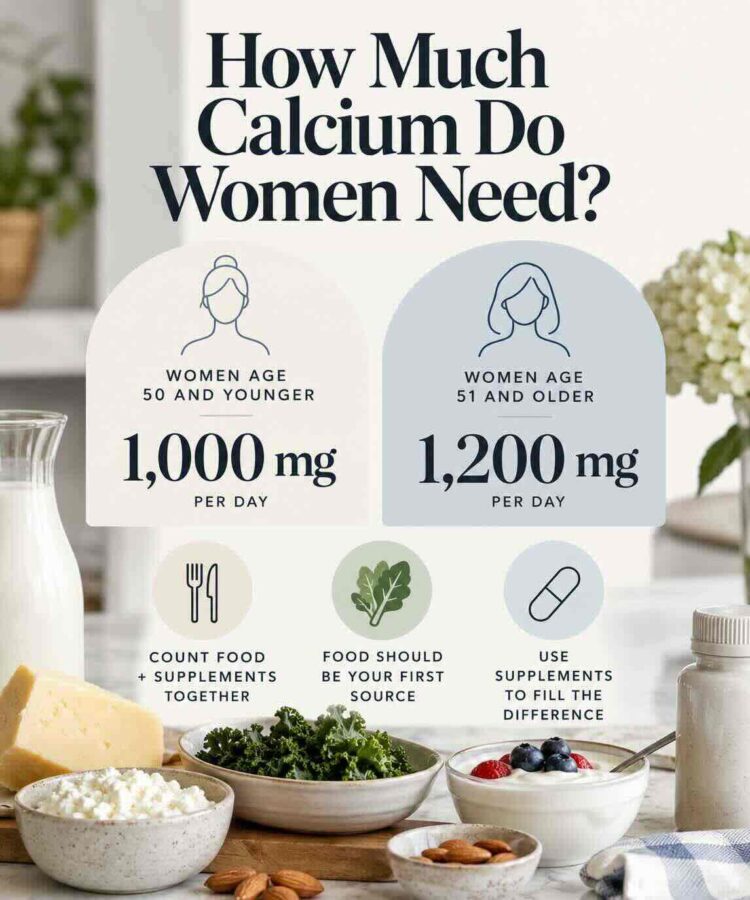
How Much Calcium Do Women Need?
General recommendations are:
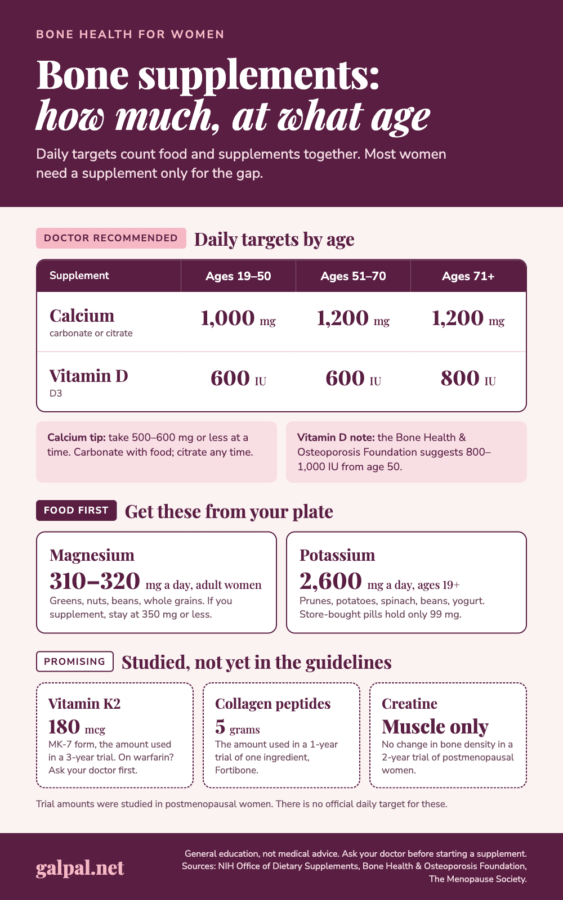
- Women age 50 and younger: 1,000 mg per day
- Women age 51 and older: 1,200 mg per day
- Count food + supplements together
- Food should be your first source
- Use supplements to fill the difference
So if you’re getting 800 mg from food, you don’t necessarily need a 1,200 mg calcium supplement.
You might only need enough to make up the shortfall.
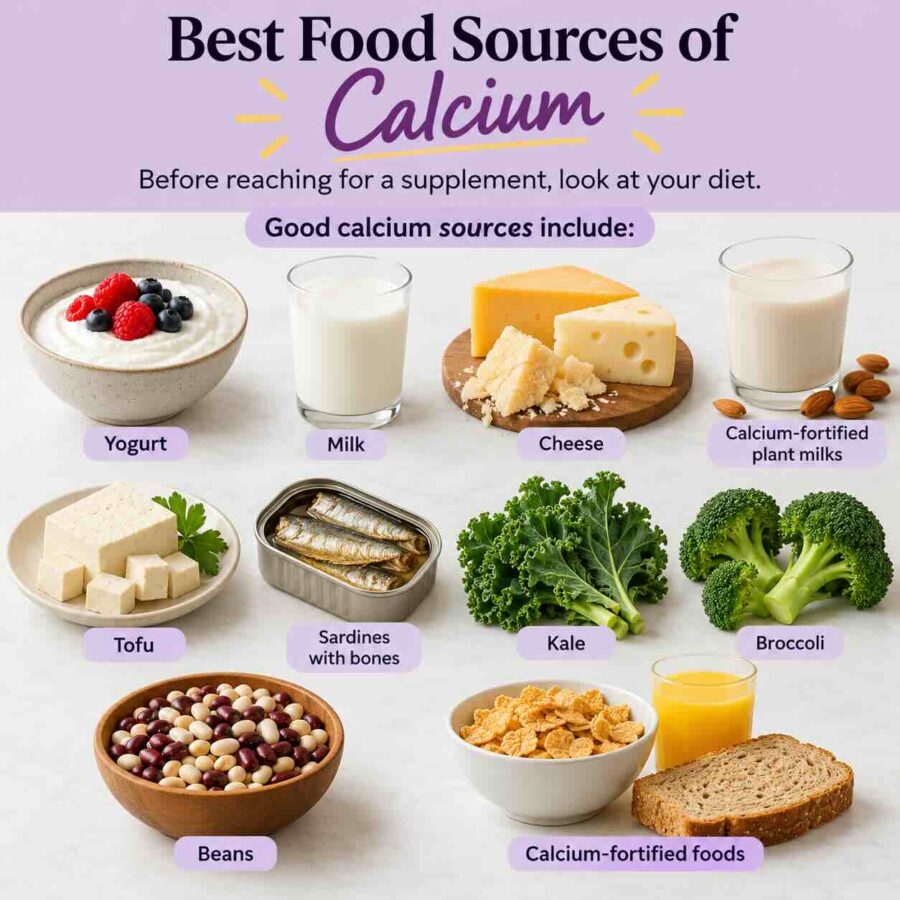
Best Food Sources of Calcium
Before reaching for a supplement, look at your diet.
Good calcium sources include:
- Yogurt
- Milk
- Cheese
- Calcium-fortified plant milks
- Tofu
- Sardines with bones
- Kale
- Broccoli
- Beans
- Calcium-fortified foods
A cup of yogurt, for example, can provide several hundred milligrams of calcium. Those little amounts add up.
Calcium Citrate vs. Calcium Carbonate
These are the two most common forms you’ll see.
Calcium Citrate
- Can be taken with or without food
- Doesn’t depend as much on stomach acid for absorption
- May be easier for some older women to tolerate
- Contains less elemental calcium per pill, so you may need more tablets
Calcium Carbonate
- Contains more elemental calcium per tablet
- Usually costs less
- Should be taken with food
- May cause more gas, bloating or constipation in some people
How to Take Calcium Supplements
This is where the details really matter.
- Take 500–600 mg or less at one time
- If you need more, divide it into two doses during the day
- Take calcium carbonate with a meal
- Calcium citrate can be taken with or without food
- Check the label for elemental calcium, not simply the weight of the entire compound
- Drink plenty of water
- If calcium causes constipation or bloating, try a smaller dose or a different form
Calcium can also interact with certain medications, including thyroid medication, so ask your doctor or pharmacist about timing.
What Doctors Recommend
Food first. Supplement only enough to reach your daily calcium target. More calcium isn’t necessarily better.
2. Vitamin D3 for Bone Health
Living in the Pacific Northwest, sometimes sunshine feels more like a rumor than an actual weather condition. So vitamin D has always made sense to me.
Vitamin D helps our bodies absorb calcium and plays an important role in maintaining healthy bones.
But once again: More isn’t necessarily better.
What Does the Research Say About Vitamin D?
A large clinical trial involving nearly 26,000 generally healthy adults found that taking 2,000 IU of vitamin D3 per day didn’t result in fewer fractures than taking a placebo.
That doesn’t mean vitamin D isn’t important.
It means that giving additional vitamin D to generally healthy people who aren’t deficient doesn’t automatically translate into stronger bones.
How Much Vitamin D Do Women Need?
General dietary recommendations are approximately:
- Ages 19–70: 600 IU (15 mcg) daily
- Over age 70: 800 IU (20 mcg) daily
The Bone Health & Osteoporosis Foundation recommends 800–1,000 IU per day for adults age 50 and older.
Your needs may be different if you have:
- Vitamin D deficiency
- Osteoporosis
- Low bone mass
- Certain digestive conditions
- Problems absorbing nutrients
- Other medical conditions affecting vitamin D
How to Take Vitamin D
Vitamin D is pretty easy to work into a routine.
- Vitamin D can be taken with or without food
- You don’t have to take vitamin D at the same time as calcium
- Check your multivitamin and calcium supplement before adding another D supplement—you may already be getting it
- For adults who need supplementation, daily lower doses are generally preferred over occasional very large doses
- Don’t assume you need a megadose because you live somewhere cloudy
What Doctors Recommend
The Endocrine Society recommends that generally healthy adults under 75 not routinely take vitamin D above the recommended dietary intake simply for disease prevention.
That’s an important distinction.
The goal is adequate vitamin D—not as much vitamin D as we can possibly fit into a capsule.
3. Vitamin D3 and K2 for Bones
If you follow midlife wellness social media accounts, you’ve probably heard about vitamin D3 and K2 for bone health.
K2 is definitely having a moment. And the science behind it is interesting.
Vitamin K helps activate proteins involved in bone mineralization and calcium metabolism.
What Does the Research Say About Vitamin K2?
Some studies in postmenopausal women have found encouraging results.
One three-year study of 244 healthy postmenopausal women found that 180 mcg per day of the MK-7 form helped slow bone loss at the spine and femoral neck.
A larger review of clinical trials has also suggested possible benefits for bone mineral density.
But the overall evidence remains mixed.
What Doctors Recommend About Vitamin K2
Major medical organizations don’t currently recommend routine K2 supplementation for osteoporosis prevention. The best supplements for bone density for women, sorted by what doctors and research include information from the Bone Health and Osteoporosis Foundation.
The Bone Health & Osteoporosis Foundation says more research is needed to determine the amount and type of vitamin K needed for bone health and currently recommends getting adequate vitamin K through food.
So I think of K2 as:
Promising—not proven.
How to Take Vitamin K2
If you and your healthcare provider decide K2 makes sense:
- MK-7 is the form commonly studied for bone health
- Many supplements combine D3 + K2
- You don’t have to take K2 simply because you take vitamin D
- Follow the product dosage rather than assuming more is better
Important Warning
Vitamin K can interfere with warfarin (Coumadin).
If you take a blood thinner, don’t add K2 without talking with your healthcare provider.
4. Magnesium for Bone Health
Magnesium is another supplement that seems to be everywhere right now.
Magnesiaium is good for : sleep, stress,muscles, constipation, bones.
Apparently magnesium has quite the résumé. It’s involved in bone structure and helps our bodies use vitamin D.
What Does the Research Say About Magnesium and Bone Density?
Research has found associations between higher magnesium intake and better bone mineral density.
But there’s an important distinction: That doesn’t prove that taking a magnesium supplement prevents osteoporosis or fractures.
What Doctors Recommend About Magnesium
Current menopause guidance doesn’t recommend routine magnesium supplementation specifically for osteoporosis in healthy adults eating a normal diet.
Good food sources include:
- Spinach and other leafy greens
- Almonds
- Pumpkin seeds
- Beans
- Whole grains
- Avocado
- Dark chocolate
Yes, I’m counting dark chocolate as good news.
Magnesium Glycinate vs. Magnesium Citrate
If you’re taking magnesium for another reason, these are two common forms.
Magnesium Glycinate
- Often chosen because it’s generally well tolerated
- Commonly taken in the evening
- Less likely to have a laxative effect than some other forms
Magnesium Citrate
- Well absorbed
- Can have a laxative effect
- May be useful for women who also struggle with constipation
How to Take Magnesium
- Follow the dose on your specific product or your healthcare provider’s recommendation
- Check multivitamins and other supplements so you don’t accidentally double up
- Taking it with food may help if it bothers your stomach
- Remember that magnesium supplements aren’t automatically necessary simply because you’re over 50
For bone health specifically, think of magnesium as an important nutrient, not a proven osteoporosis treatment.
5. Collagen Peptides for Bone Density
This one surprised me.
I’ve always put collagen into the skin, hair and joint category.
But our bones contain a collagen framework, too.
Think of collagen as part of the scaffolding that gives bone its structure.
Does Collagen Help Bone Density?
Here’s where the research gets interesting. In one randomized year-long study, 131 postmenopausal women with low bone density received either specific collagen peptides or a placebo.
The women taking 5 grams of specific collagen peptides per day experienced improvements in bone mineral density at the lumbar spine and femoral neck. That’s enough to get my attention.
But there’s an important catch.
Not All Collagen Is the Same
The study used a specific branded collagen peptide ingredient called FORTIBONE®.
So we can’t automatically assume that every collagen powder sitting on the shelf provides the same bone benefits.
How to Take Collagen Peptides
Based on the clinical research:
- The studied amount was 5 grams daily
- The research involved specific collagen peptides
- Look for FORTIBONE® on the ingredient list if you’re specifically interested in the bone research
- Collagen can easily be mixed into coffee, smoothies or other drinks
- Consistency matters more than taking it at a particular time of day
What Doctors Recommend
Collagen isn’t currently included as a standard osteoporosis treatment.
So I’d classify collagen as: Promising research—not yet standard medical guidance.
6. Creatine for Women Over 50
Creatine may win the award for Most Talked About Midlife Supplement right now. And there’s good reason for some of the excitement. Maintaining muscle as we age is incredibly important. But I wanted to know: Does creatine actually build bone?
What Does the Research Say About Creatine and Bone Density?
A two-year randomized trial studied postmenopausal women taking creatine while participating in an exercise program. Creatine didn’t significantly improve bone mineral density.
However, researchers found improvements in some measures of bone geometry, and creatine supported gains in lean muscle.
That’s still valuable.
Strong muscles help us:
- Lift heavier weights
- Maintain balance
- Stay active
- Maintain independence
- Support our joints
- Reduce fall risk
And strong muscles allow us to continue doing the resistance and impact exercises that actually challenge our bones.
How to Take Creatine
For women taking creatine primarily for muscle and strength:
- Choose creatine monohydrate
- A common research-supported amount is 3–5 grams daily
- You generally don’t need a loading phase
- Take it consistently
- Timing isn’t nearly as important as taking it regularly
- Mix it into water, a smoothie or another beverage
- Look for reputable third-party testing, such as NSF Certified for Sport
You also don’t need a pink tub labeled “Women’s Creatine.”
Plain creatine monohydrate does the job just fine.
What Doctors and Research Say
Creatine isn’t currently recommended as an osteoporosis treatment.
I think it’s more accurate to call it a healthy-aging and muscle supplement that may indirectly support our bone-health strategy.
Supplements Doctors Don’t Routinely Recommend for Bone Health
Rather than labeling supplements as “good” or “bad,” I think the better question is:
Is there enough evidence for doctors to routinely recommend this for bone health?
For several supplements, the answer is currently no.
Strontium
Over-the-counter strontium supplements aren’t routinely recommended for osteoporosis because there isn’t adequate evidence establishing their effectiveness and safety.
Herbal Bone Supplements
Current osteoporosis guidance doesn’t provide compelling evidence for supplements such as:
- Black cohosh
- Berberine
- DHEA
- Boron as an osteoporosis treatment
- Multi-herb “bone formulas”
Multi-Ingredient Bone Blends
Be careful with supplements containing a long list of vitamins, minerals and herbs.
Instead ask:
- What exactly is in this?
- How much of each ingredient am I getting?
- Is that dose supported by research?
- Am I already getting the same ingredient from another supplement?
- Has the product been independently tested?
More ingredients don’t automatically mean more benefit.
How to Choose a Quality Supplement
This may be one of the most useful things I learned.
A beautiful label doesn’t tell us much about what’s actually inside the bottle.
Look for reputable independent third-party testing.
USP Verified
USP verification can help confirm that a supplement contains the ingredients and amounts stated on its label and meets specified quality standards.
NSF Certified
NSF certification is another form of independent product testing.
For athletic supplements such as creatine, you may also see NSF Certified for Sport.
But remember:
Third-party certification tells us about product quality. It doesn’t prove that taking the ingredient will improve bone density.
Those are two different things.
Best Bone Health Supplements for Women: Easy Cheat Sheet
| Supplement | What Research Says | How to Take It |
|---|---|---|
| Calcium | Important when diet falls short | 500–600 mg or less at once; carbonate with food; citrate with or without food |
| Vitamin D3 | Important for calcium absorption | Daily; check other supplements for D before adding more |
| Vitamin K2 | Promising but not routinely recommended | MK-7 is commonly studied; check with doctor, especially with blood thinners |
| Magnesium | Important nutrient; limited evidence as an osteoporosis supplement | Glycinate or citrate are common forms |
| Collagen peptides | Promising research in postmenopausal women | Research used 5 g/day of specific collagen peptides |
| Creatine | Stronger evidence for muscle than bone density | Creatine monohydrate, commonly 3–5 g daily |
| Strontium | Not routinely recommended | Discuss with your healthcare provider |
Can You Take Bone Health Supplements Together?
This was another question I had. In many cases, yes—but that doesn’t mean they all need to be swallowed at breakfast together.
A simple routine might look something like this:
Morning
- Vitamin D3
- Vitamin K2, if recommended for you
- Collagen peptides mixed into coffee or another beverage
- Creatine monohydrate mixed into a drink
With a Meal
- Calcium carbonate, if that’s the form you use
Anytime
- Calcium citrate can be taken with or without food
- Vitamin D doesn’t have to be taken at the same time as calcium
Evening
- Magnesium, if it’s part of your routine
The important thing is to check all of your bottles.
Your multivitamin may already contain vitamin D. Your calcium supplement may contain vitamin D. Another supplement may contain magnesium.
It’s surprisingly easy to double up without realizing it.
And medication interactions matter, particularly with calcium and thyroid medication and vitamin K with warfarin.
The Best Thing I’m Doing for My Bones Isn’t a Supplement
After all this research, I keep coming back to one thing.
We can spend an enormous amount of time analyzing supplements when some of the most important things we can do for our bones don’t come in bottles at all.
Resistance training, weight-bearing exercise and impact exercise matter tremendously.
Which brings me back to my stairs.
My husband has teased me for years about how loudly I go up them.
Apparently, I don’t walk upstairs.
I stomp.
For years, this was presented as a mildly annoying personality trait.
Not anymore.
Now when he asks, “Do you have to stomp up the stairs?”
I have the perfect answer:
“I’m building bone.”
Science has finally given me the comeback I’ve been waiting for.
My bigger bone-health strategy is about:
- Lifting heavy weights
- Jumping and other appropriate impact exercises
- Climbing stairs
- Walking and staying active
- Eating enough protein
- Getting adequate calcium and vitamin D
- Maintaining muscle
- Getting appropriate bone-density screening
Supplements can help fill nutritional gaps.
But they’re the supporting cast—not the star of the show.
Frequently Asked Questions About Bone Health Supplements for Women
What Are the Best Supplements for Bone Density?
Calcium and vitamin D are the nutrients most consistently addressed in medical bone-health recommendations. The goal is adequate intake rather than automatically taking large supplemental doses.
Vitamin K2 and specific collagen peptides have promising research, while magnesium is an essential nutrient but isn’t routinely recommended specifically as an osteoporosis supplement.
What Is the Best Calcium Supplement for Women Over 50?
Both calcium citrate and calcium carbonate can provide calcium.
Calcium citrate can be taken with or without food, while calcium carbonate should generally be taken with food. Calcium citrate may also be easier for some older adults to absorb.
The best dose depends on how much calcium you’re already getting through your diet.
When Is the Best Time to Take Calcium?
Timing matters less than the amount.
Your body absorbs calcium best in amounts of approximately 500 mg or less at one time, so larger supplemental amounts should generally be divided.
Can You Take Too Much Calcium?
Yes.
More calcium doesn’t automatically create stronger bones. Women over 50 generally need approximately 1,200 mg per day from food and supplements combined.
Should Women Take Vitamin D3 and K2 Together?
They can be taken together, and many products combine them. However, K2 isn’t currently routinely recommended for osteoporosis prevention.
If you take warfarin or another medication affected by vitamin K, talk with your healthcare provider first.
Does Collagen Help Bone Density?
Some research involving specific collagen peptides in postmenopausal women is promising. However, collagen isn’t currently a standard treatment for osteoporosis.
Is Creatine Good for Women Over 50?
Creatine monohydrate has good evidence for supporting muscle mass, strength and physical performance.
Current research doesn’t support calling creatine a treatment for low bone density, but maintaining muscle is an important part of healthy aging and fall prevention.
Can I Take Calcium, Vitamin D, Magnesium and Collagen Together?
Many people can, but whether you need all four is a different question.
Look at your diet, medications, multivitamin and existing supplements before adding more. Your healthcare provider or pharmacist can also check for medication interactions and unnecessary duplication.
The Gal Pal Bottom Line
After researching all of this, my supplement philosophy has become much simpler.
- Start with food.
- Know what you’re already getting.
- Supplement genuine gaps.
- Don’t assume a larger dose is better.
- Choose supplements with reputable third-party testing.
- Pay attention to medication interactions.
- Put more energy into exercise than into collecting bottles.
We don’t need every supplement marketed to women over 40 or 50.
I’d much rather spend my money on a good set of dumbbells than another mystery bottle for my supplement cabinet.
And apparently, my stair-stomping workouts are completely free.
Now I’m curious: If you lined up every supplement you take on your kitchen counter, could you explain exactly why you’re taking each one?
I dare you to try it.
This article is for educational purposes only and isn’t medical advice. Supplement needs can differ based on diet, age, medications, medical conditions and bone density. Talk with your healthcare provider or pharmacist before changing your supplement routine.