Bone Density Exercises for Women: Backed By Science
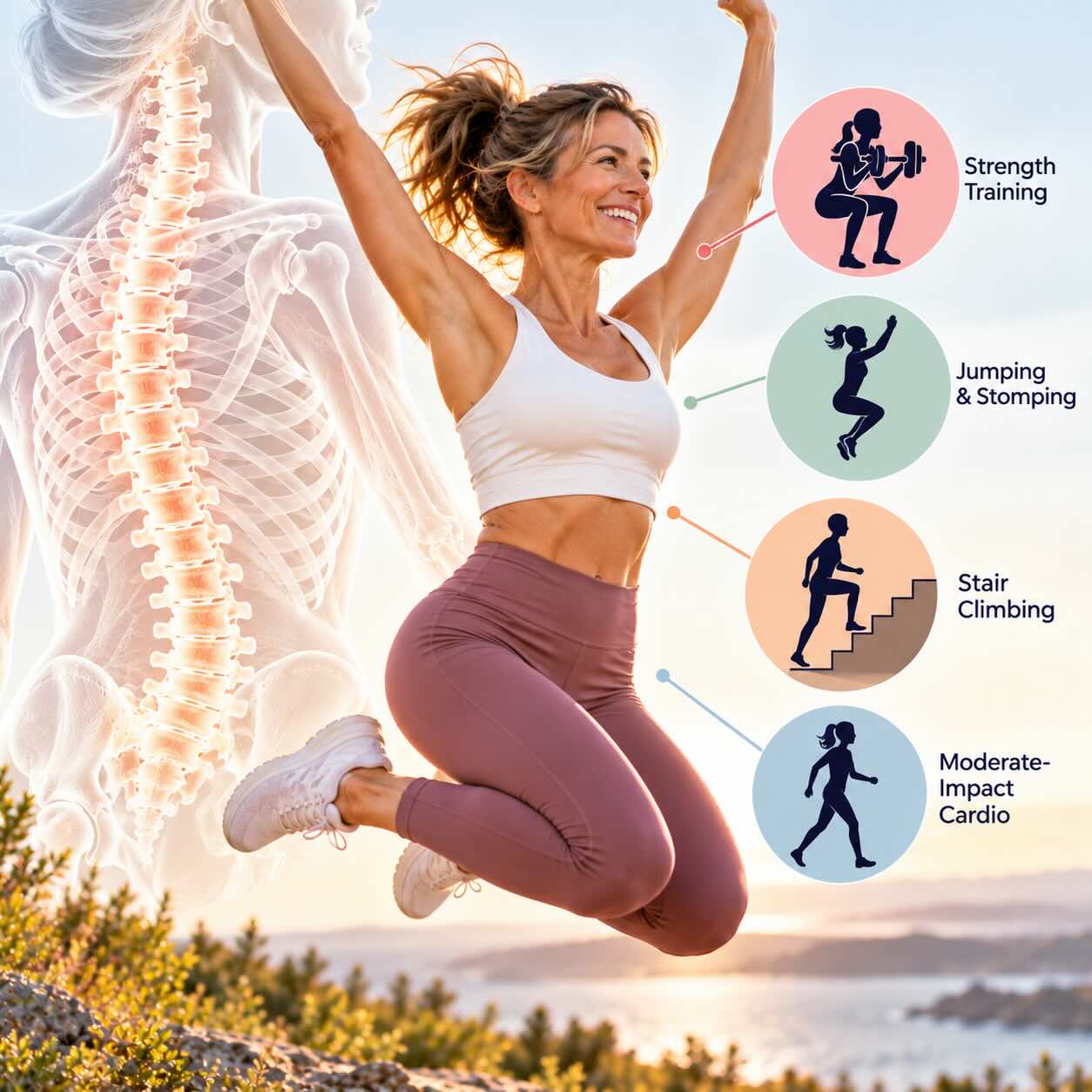
My husband has an ongoing joke about the way I walk up our stairs. Apparently, he can tell exactly when I am heading up the stairs from anywhere in the house. I don’t walk I stomp. I take those stairs with purpose. Let’s just call it what it is: I’m a stair stomper. The good news? Stomping is one of the best bone density exercises you can do. Discover the best exercises for bone density backed by science and research. Learn which activities can strengthen your bones and enhance overall health. Some will surprise you.
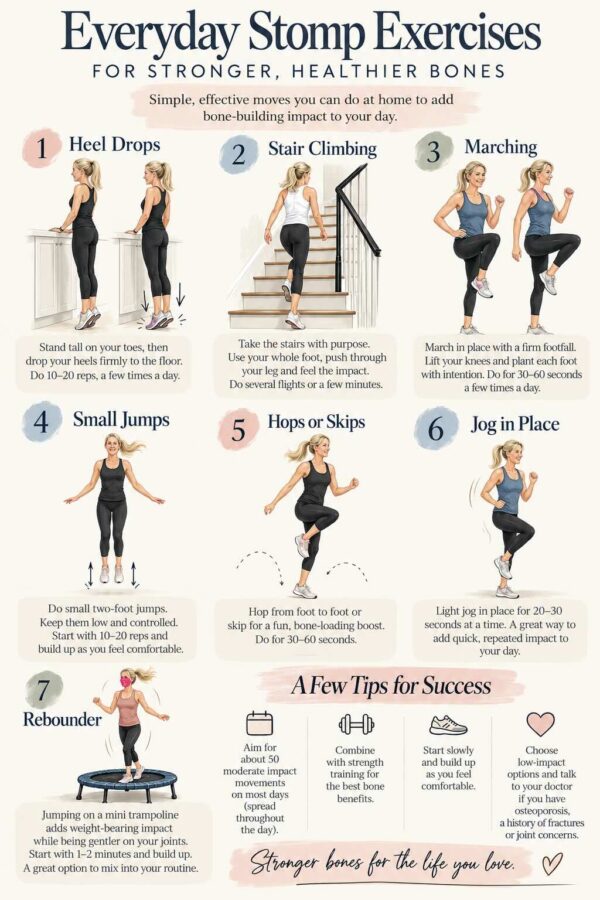
Turns out, my stair stomping may actually be doing my bones a favor. Research shows that weight-bearing impact—when your feet hit the ground with some force, creates mechanical stress that signals bones to stay strong and adapt.
Activities like climbing stairs, heel drops and jumping can all provide this type of bone-building stimulus. So the next time my husband complains about hearing me coming up the stairs, I’ll remind him: I’m not stomping—I’m working on my bone density.
Key Takeaways
- Bone density exercises are crucial to prevent osteoporosis, especially for women as they age.
- Heavy resistance training has the strongest research backing, significantly improving bone density.
- High-impact jumping and stomping are effective alternatives that help build bone strength without heavy equipment.
- Stair climbing promotes functional strength, while moderate-impact cardio supports bone health as a complementary habit.
- Avoid swimming and cycling for bone density; they lack mechanical loading necessary for bone growth.

Why Keeping Your Bones Strong Matters As You Age
As we all know, our bones start to breakdown in our mid 30’s. We also know the importance for women to protect our bone strength. So lets discuss our how to increase bone density naturally to prevent osteoporosis.
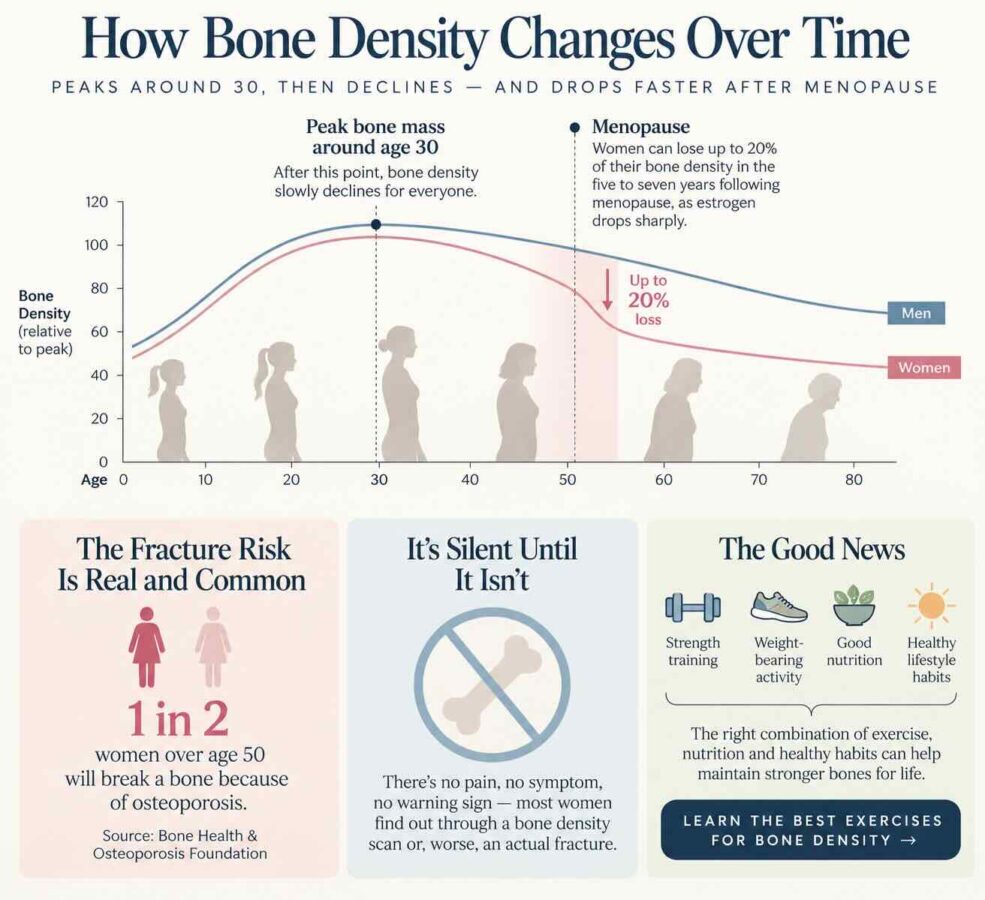
Here’s what the research shows:
- Peak bone mass happens around age 30, after which density slowly declines for everyone, regardless of gender.
- Menopause accelerates it dramatically. Women can lose up to 20% of their bone density in the five to seven years following menopause, as estrogen — which helps protect bone — drops sharply.
- The fracture risk is real and common. According to the Bone Health & Osteoporosis Foundation, 1 in 2 women over age 50 will break a bone because of osteoporosis.
- It’s silent until it isn’t. There’s no pain, no symptom, no warning sign — most women find out through a bone density scan or, worse, an actual fracture. Learn what the best exercises for bone density are.
The good news: bone responds to exercise the same way muscle does. The right kind of stress — real mechanical force — signals your body to reinforce itself. Below are the five categories of exercise with the strongest research behind them, ranked from most to least evidence, with the studies, examples, and exactly how to do each one.
The Top Exercises for Bone Density
There are five best exercises for women that supports bone density. Simple exercises we all can do.
1. Heavy Resistance Training
The single most evidence-backed category for building bone density, and the one most women skip out of fear that lifting heavy is risky. The research says the opposite.
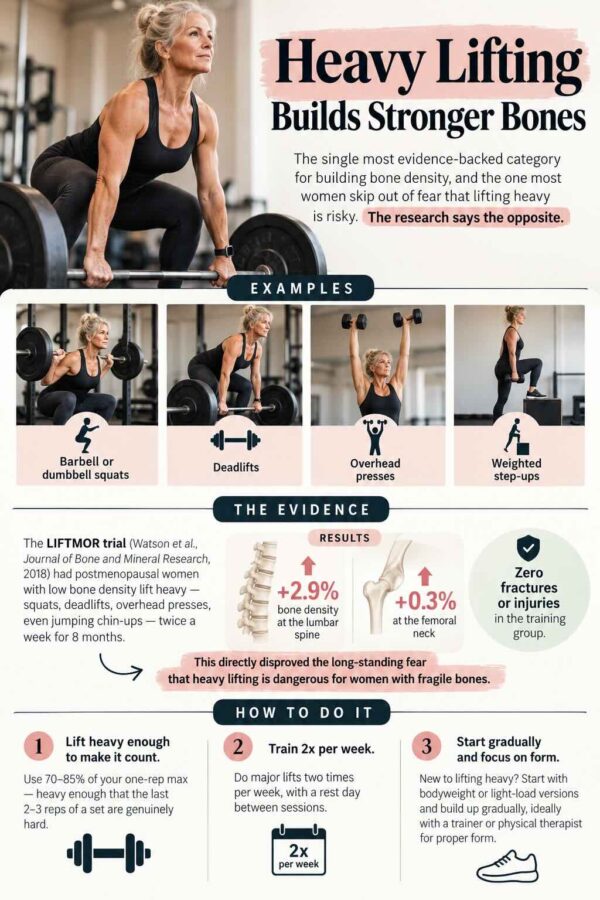
Examples of resistance exercises
- Barbell or dumbbell squats
- Deadlifts
- Overhead presses
- Weighted step-ups
The Scientific Evidence
- The LIFTMOR trial (Watson et al., Journal of Bone and Mineral Research, 2018) had postmenopausal women with low bone density lift heavy — squats, deadlifts, overhead presses, even jumping chin-ups — twice a week for 8 months.
- Results: +2.9% bone density at the lumbar spine and +0.3% at the femoral neck, with zero fractures or injuries in the training group.
- This directly disproved the long-standing fear that heavy lifting is dangerous for women with fragile bones.
How to Do It
- Lift at 70–85% of your one-rep max — heavy enough that the last 2–3 reps of a set are genuinely hard.
- Train major lifts 2x per week, with a rest day between sessions.
- New to lifting heavy? Start with bodyweight or light-load versions and build up gradually, ideally with a trainer or physical therapist for form.
2. High-Impact Jumping
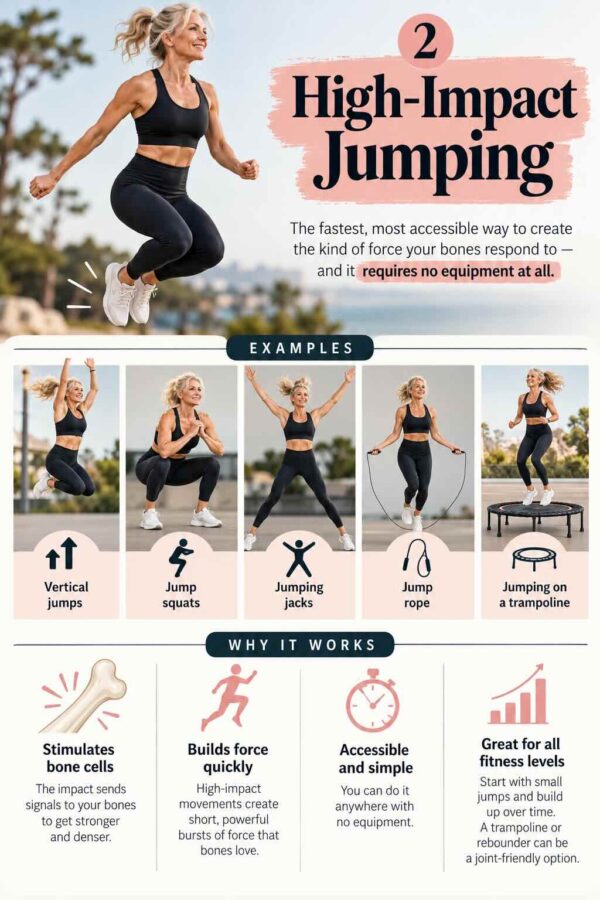
The fastest, most accessible way to create the kind of force your bones respond to — and it requires no equipment at all.
Examples of high-impact jumping
- Vertical jumps
- Jump squats
- Jumping jacks
- Jump rope
- Jumping on a trampoline
The Scientific Evidence
- A landmark 1994 study (Bassey & Ramsdale, Osteoporosis International) found premenopausal women who did 50 jumps a day gained 2.8% more femoral bone density in just 5 months.
- A 2023 meta-analysis in the Journal of Bone and Mineral Research, pooling dozens of randomized trials, found roughly a 4% average bone density improvement at the hip and spine from impact training.
- The forces involved — 4 to 6 times body weight on landing — are what actually trigger new bone formation.
How to Do It
- Start with jumping jacks if you’re new to impact training.
- Build toward 2–3 sets of 10 jumps, a few times a week.
- Land softly but firmly, with bent knees — a controlled landing, not a stomp-free tiptoe.
3. Stomping
The lesser-known alternative that hits nearly the same bone-building threshold as a jump, without the landing impact — a genuinely useful option for sensitive joints.
Examples of stomping
- A deliberate, heel-first, full-weight stomp in place
- Stomping up a flight of stairs instead of walking softly
The Scientific Evidence
- A study measuring the actual forces produced by a stomp found that at a moderate effort level, it generates roughly 3 times body weight — meeting the minimum threshold researchers identify as necessary for bone growth.
- At a higher effort level, stomping produced 4.4–4.6 times body weight, comparable to or exceeding a two-footed jump.
- Researchers concluded stomping can be safely self-regulated and is a useful substitute “where jump-landings may be contraindicated.”
How to Do It
- Plant your whole foot with real, deliberate force — not a light tap.
- Use it anywhere you’d normally walk softly: up the stairs, across the kitchen, during a commercial break.
4. Stair Climbing
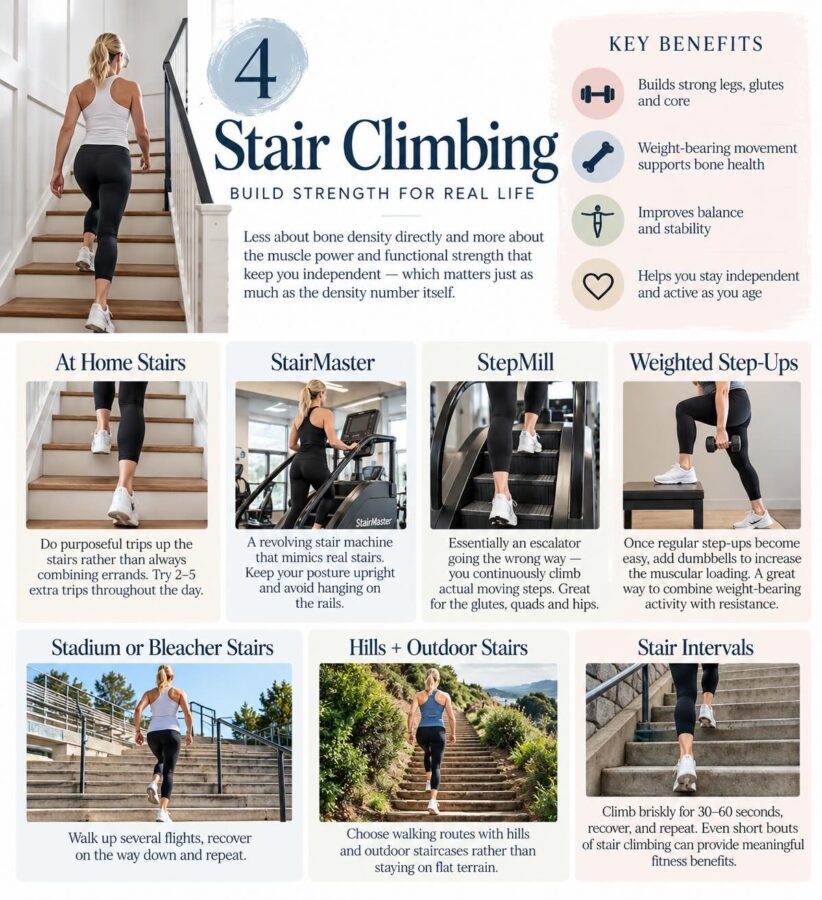
Less about bone density directly and more about the muscle power and functional strength that keep you independent — which matters just as much as the density number itself.
Examples Of Doing Stairs
- Do purposeful trips up the stairs rather than always combining errands.
- Try 2–5 extra trips throughout the day.
- StairMaster / revolving stair machine: Probably the closest gym equivalent to continuously climbing real stairs. Keep your posture upright and avoid hanging your body weight on the rails.
- StepMill: Essentially an escalator going the wrong way—you continuously climb actual moving steps. It’s excellent for the glutes, quads and hips.
- Weighted step-ups: Once regular step-ups become easy, holding dumbbells increases the muscular loading component. This is a nice way to combine weight-bearing activity with resistance.
- Stadium or bleacher stairs: Walk up several flights, recover on the way down and repeat.Hill + stair walking: Choose walking routes with hills and outdoor staircases rather than staying on flat terrain.
- Stair intervals: Instead of 20 minutes continuously, climb briskly for 30–60 seconds, recover, and repeat. Research shows even home-based stair-climbing bouts can provide meaningful fitness benefits. PubMed Central (PMC)
The Scientific Evidence
- A randomized trial on stair-climbing protocols found measurable gains in muscle strength, walking speed, and the ability to stand up from a chair without using the hands — a key marker of long-term independence.
- Related research protocols used 12-week programs, twice a week, progressing from slow step-ups to full flights of stairs.
How to Do It
- Skip the elevator when you reasonably can.
- Once flights feel easy, pick up your pace or add a light weighted vest.
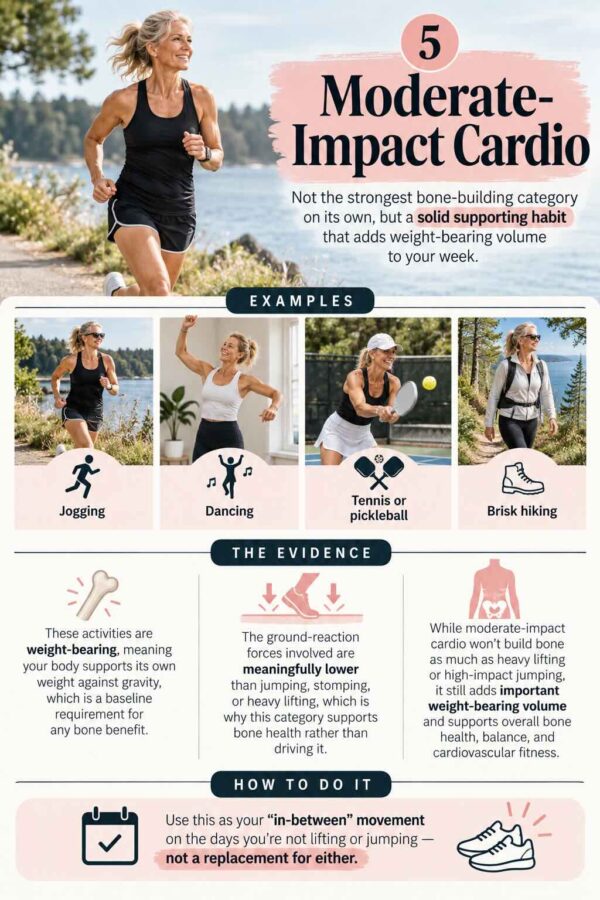
5. Moderate-Impact Cardio
Not the strongest bone-building category on its own, but a solid supporting habit that adds weight-bearing volume to your week. Wear a weighted vest for best results.
Examples
- Jogging
- Dancing
- Tennis or pickleball
- Brisk hiking
The Scientific Evidence
- These activities are weight-bearing, meaning your body supports its own weight against gravity, which is a baseline requirement for any bone benefit.
- The ground-reaction forces involved are meaningfully lower than jumping, stomping, or heavy lifting, which is why this category supports bone health rather than driving it.
How to Do It
- Use this as your “in-between” movement on the days you’re not lifting or jumping — not a replacement for either.
What Doesn’t Help (and Why)
- Swimming and cycling are excellent for your heart and joints, but they happen in a weightless or seated position.
- No mechanical loading on the skeleton means no signal for your bones to strengthen — these are cardiovascular wins, not bone-density wins.
Who Should Talk to a Doctor First
- Diagnosed osteoporosis or very low bone density
- Early menopause
- A history of fractures
- Any joint, balance, or cardiovascular condition
Impact and resistance training are actually recommended for most people with low bone density — but the how much and how hard should be personalized with a doctor or physical therapist, not pulled from a blog post.
Frequently Asked Questions
What’s the single best exercise for bone density?
Heavy resistance training currently has the strongest research behind it, but the biggest gains come from combining it with high-impact work like jumping — they build bone through slightly different mechanisms.
How soon will I see results?
The studies referenced here saw measurable bone density changes over 5 to 8 months of consistent training. This is a slow-building process, not a quick fix.
I’m intimidated by heavy lifting. Where do I start?
Start with bodyweight squats and step-ups to build form and confidence, then add light dumbbells before progressing toward true heavy loads — ideally with guidance from a trainer or physical therapist.
Can I combine these exercises in one week?
Yes — and it’s ideal. A realistic week might include 2 resistance sessions, a few minutes of jumping or stomping on 2–3 days, stairs as a daily habit, and cardio on the remaining days.
Research & Sources
1. Watson, S.L. et al. (2018). “High-Intensity Resistance and Impact Training Improves Bone Mineral Density and Physical Function in Postmenopausal Women With Osteopenia and Osteoporosis: The LIFTMOR Randomized Controlled Trial.” Journal of Bone and Mineral Research. Wiley Online Library
2. Bassey, E.J. & Ramsdale, S.J. (1994). “Increase in femoral bone density in young women following high-impact exercise.” Osteoporosis International. PubMed
3. “Effects of Moderate- to High-Impact Exercise Training on Bone Structure Across the Lifespan: A Systematic Review and Meta-Analysis of Randomized Controlled Trials.” (2023). Journal of Bone and Mineral Research. Oxford Academic
4. “The Quantification, Autoregulation and Reliability of the Stomp as an Osteogenic Exercise.” Gavin Publishers
5. “Stair-Climbing Versus Machine-Based Resistance Exercise to Improve Muscle Power Among Older Adults: A Noninferiority Trial.” PubMed
6. “What Women Need to Know.” Bone Health & Osteoporosis Foundation. bonehealthandosteoporosis.org
7. “Menopause and Bone Loss.” Endocrine Society. endocrine.org