
Why Midlife Is Your Power Decade – Backed By Science
There’s a story most women have been told about midlife. It goes something like this: things start to decline, your body changes in ways you didn’t ask for, your kids leave or your husband drifts, and your career plateaus. Somewhere in your mid-forties you’re supposed to have a midlife crisis and mourn the youth you’ve left behind. I am here to tell you that midlife is actually your power decade based on research and science.
Key Takeaways
- Midlife women experience a powerful transition, often considered their ‘power decade’ rather than a crisis.
- Research shows midlife women gain self-confidence, emotional resilience, and a clearer sense of purpose.
- Studies indicate that midlife is a time of increased wisdom, where emotional intelligence and problem-solving skills peak.
- Community support and mental health care are crucial for midlife women, impacting their wellbeing and longevity.
- Midlife women are leading significant changes in business and society, challenging traditional narratives about aging.
Here at Gal Pal, we’ve been in conversation with thousands of women navigating this life stag. I am hear to tell you the future is bright ladies! Your life isn’t decline, it’s more about entering your power years.
So let’s talk about what’s actually happening during midlife, what the research says, and why this moment might be the most important and fulfilling decade of your life.
So What Even Is Midlife Anymore?
Before we go further, let’s address the obvious question: with people living longer than ever, what does “midlife” actually mean today?
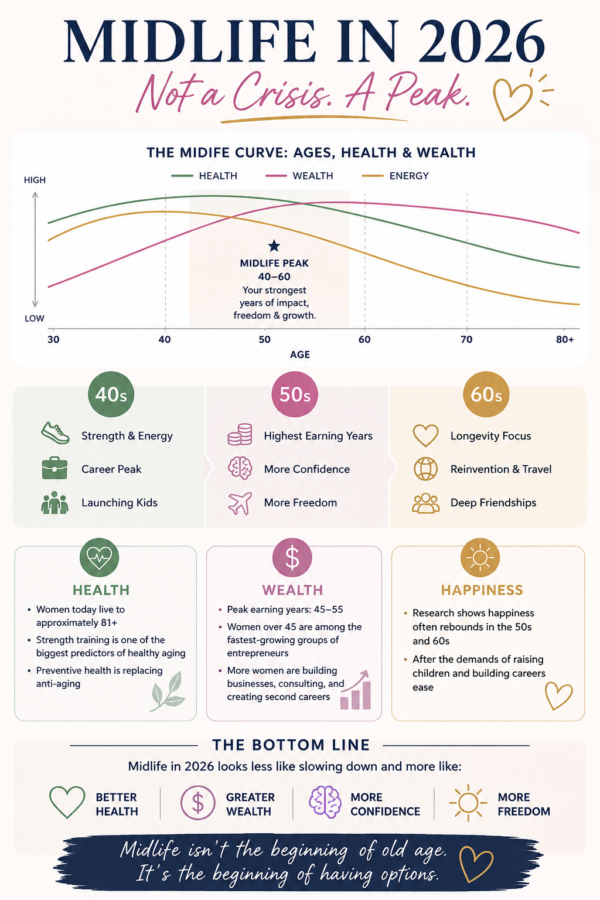
The short answer, it’s shifted. In the 1950s, U.S. life expectancy was around 68. Today it’s nearly 79 and climbing. That fundamentally changes where the middle falls.
Most researchers now place midlife between 40 and 65, with some extending it further. Stanford’s Center on Longevity has even coined the term “middlescence” to describe this newly expanded phase — treating it as its own distinct developmental stage rather than a waiting room for old age.
- Current expert consensus puts midlife at roughly ages 40–65, with the upper boundary shifting as lifespans grow. → Psychology Today: Midlife
- Stanford’s Center on Longevity defines “middlescence” as a transformative new life stage created by longer, healthier lifespans — one that deserves its own roadmap. → Stanford Center on Longevity: Middlescence
- One U.S. study found that a third of people in their 70s still consider themselves middle-aged. Subjective age — how old you feel — turns out to be a stronger predictor of wellbeing than your birth year. → Biology Insights: When Is Middle Age?
If you’re somewhere between 40 and 65 and you feel like you’re in the middle of your story — you probably are. The science agrees.
The Midlife Crisis Myth
The phrase “midlife crisis” has been around since the 1960s. And while it makes for a good punchline, the science tells a very different story.
Most women don’t experience midlife as a crisis at all. Global research consistently shows that life satisfaction follows in a U-shaped curve. It dips in midlife relative to early adulthood and older age, but it absolutely does not collapse into crisis for the majority of people.he science actually says:
Global Science About Midlife:
- Economists David Blanchflower and Andrew Oswald studied 500,000 people across the U.S. and Europe and found the happiness dip in midlife is real but remarkably small — more of a wobble than a collapse, with happiness scores staying in the low 7s out of 10. → Blanchflower & Oswald, “Is Well-being U-Shaped over the Life Cycle?”
- A follow-up analysis across 145 countries confirmed the U-shape exists globally, but also found that the dip is modest in magnitude and that most people recover strongly in their fifties and beyond. → Springer Nature: “Is happiness U-shaped everywhere?”
- A critical review published in PMC found that the U-shape varies significantly by country and demographic, and that many researchers concluded the happiness dip was “too small to be meaningful in practical terms.” → PMC: “The U-shape of Happiness Across the Life Course: Expanding the Discussion”
In fact, a growing body of evidence suggests that women in midlife ( roughly ages 40 to 60 ) report higher levels of self-confidence, greater emotional resilience, and a sharper sense of purpose than they did in their twenties and thirties.
So why does the crisis narrative persist? Partly because it’s dramatic and it sells. Partly because society has long viewed women through the lens of youth and fertility, and when those things shift, it calls it a loss.
It’s time we give that narrative a second opinion.
Midlife is a major opportunity for women to reinvent their careers, invest in long-term health, and shape the economy.
What Midlife Actually Looks Like for Women
Let’s describe what most women are actually experiencing in midlife — beyond the symptoms and the cultural noise.
You’re tired, yes. But often, you’re tired because you’ve been carrying enormous weight: careers, kids, aging parents, community responsibilities, and in many cases, the emotional labor of holding everything together. That exhaustion isn’t a sign of decline. It’s a sign that you’ve been doing a tremendous amount.
You may be experiencing physical changes — shifts in sleep, energy, hormones. These are real, and they matter. Healthcare for midlife women has historically been underfunded and under-researched, which means many women have suffered through symptoms without proper support or answers. That’s a failure of the system, not a failure of your body.
And yet — underneath all of that — something else is happening too. Something worth paying attention to.
The Science of Wisdom
Here’s a truth that doesn’t get nearly enough attention: the brain in midlife is extraordinarily capable.
Research on cognitive development shows that while some processing speeds change with age, key abilities actually peak in midlife. Pattern recognition, emotional regulation, complex problem-solving, the capacity to hold multiple perspectives simultaneously — these are midlife superpowers, honed by decades of lived experience.
The evidence is compelling:
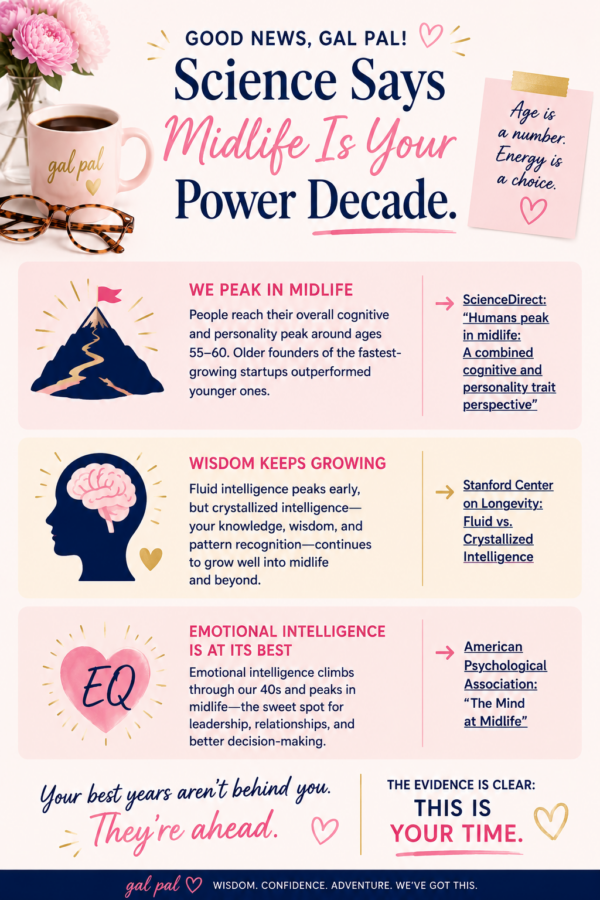
- A recent study found that people tend to reach a unique peak between ages 55 and 60 when you combine wisdom, emotional intelligence, life experience, sound judgment, and conscientiousness. In other words, we’re not slowing down—we’re becoming more capable. In fact, researchers found that founders of some of the fastest-growing companies often outperformed their younger counterparts.. → ScienceDirect: “Humans peak in midlife: A combined cognitive and personality trait perspective”
- While we may not process information quite as quickly as we did at 25, something even more valuable is happening. Our “crystallized intelligence”—the wisdom, pattern recognition, and knowledge we’ve built over decades—continues to grow well into midlife and beyond.→ Stanford Center on Longevity: Fluid vs. Crystallized Intelligence
- Emotional intelligence climbs steadily through the forties, and midlife is confirmed as a “sweet spot” for the complex integration of emotion and higher-order thinking — skills that matter most in leadership, relationships, and decision-making. → American Psychological Association: “The Mind at Midlife”
Wisdom isn’t just a soft concept. It has measurable components, and studies confirm that it tends to develop most richly in the middle decades of life.
The workforce is slowly waking up to this point. Women in midlife are among the most productive, reliable, and creatively capable workers — bringing perspective and institutional knowledge that younger employees are still building.
Midlife Transition to Transformation
Midlife is a stage of significant transition. There’s no question about that. But transition isn’t the same as crisis, and uncertainty isn’t the same as suffering.
Many women find that the transitions of midlife — children growing up, careers evolving, relationships deepening or changing, parents aging — actually create space. Space to ask: What do I actually want? What matters to me now? What have I been waiting to do?
That’s not a crisis. That’s a beginning.
The moment you stop defining yourself primarily by what you do for others, and start asking what you truly value, something shifts. Women in their forties and fifties describe this shift as one of the most liberating experiences of their lives.
Your Mental Health Deserves the Spotlight
Let’s talk about mental health, because it’s inseparable from this conversation.
Midlife women are at a heightened risk of anxiety and depression. This is not because midlife is inherently dark, but because of the accumulated pressures, hormonal factors, and the reality that many women have been putting their own mental health last for decades.
If you’re struggling, that’s not weakness. It’s an understandable response to an enormous amount of load. And you deserve support — whether that’s therapy, community, lifestyle changes, or simply being seen and heard.
The research is clear that therapy works. Investing in your mental health during this stage isn’t a luxury. It’s one of the most strategic things you can do for your quality of life in the decades ahead.
The mental health research tells us:
- The Study of Women’s Health Across the Nation (SWAN) found that midlife mental health factors including social support and a strong sense of purpose — are among the most powerful predictors of psychological wellbeing decades later. Investing in your mental health now pays compound interest. → PMC: “Midlife Factors Related to Psychological Well-Being at an Older Age”
- Research from Boston University confirms that problem-focused coping strategies — including therapy, community support, and active problem-solving — are significantly more effective at reducing distress in midlife women than passive waiting or avoidance. → Deborah Carr, BU: “Midlife and Mental Health” research brief
We also want to acknowledge the compounding factors: financial stress, worsened health access in certain regions, racial disparities in healthcare, and the particular weight carried by women who are simultaneously raising kids and supporting aging parents.
Midlife Women Are Leading the World
Here’s something society doesn’t say loudly enough: midlife women are running things.
Look at who leads major businesses, nonprofits, hospitals, schools, and government agencies. Look at who shows up, who follows through, who builds community. Midlife women are disproportionately represented among leaders who actually move the needle — not because they waited their turn, but because they’ve done the work.
In America and globally, women in their forties and fifties are launching businesses at remarkable rates. They’re entering the workforce in new ways, starting second careers, monetizing decades of expertise, and creating jobs.
The research numbers that back this up:
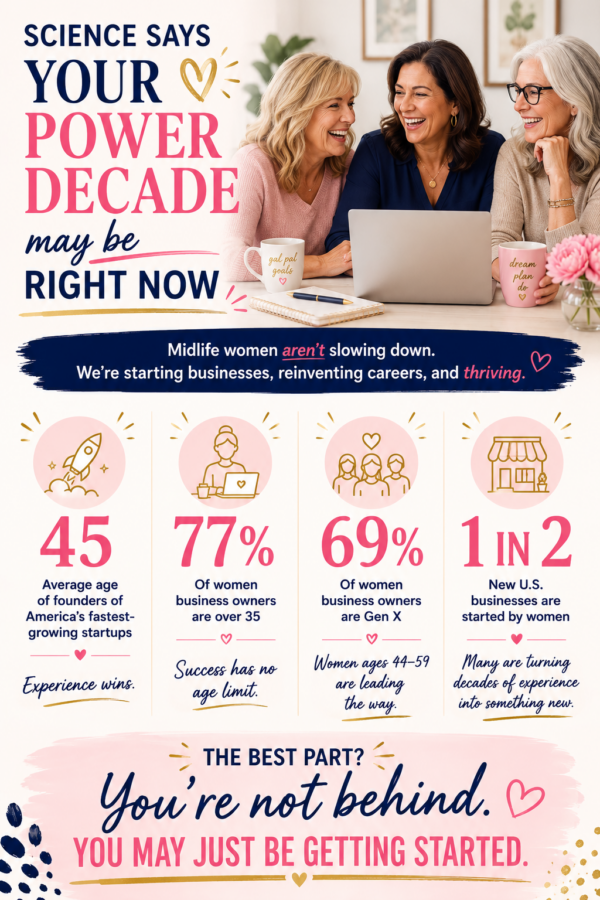
- An MIT Sloan School of Management study analyzed 1,700 founders of the fastest-growing new ventures in the U.S. The average founder age was 45 — and older founders had significantly higher success rates than their younger counterparts. Experience wins. → Gusto: Women’s Entrepreneurship Report 2025
- 76.9% of women business owners are over 35. Gen X women — ages 44 to 59 — make up 69% of all women business owners in America today. → Clarify Capital: 50 Women in Business Statistics
- By 2024, women were launching nearly 1 in 2 new businesses in the U.S., with midlife women driving a significant share of that growth — motivated by flexibility, autonomy, and decades of expertise they’re finally deploying on their own terms. → Gusto: Women’s Entrepreneurship Report 2025
The idea that midlife represents a retreat from relevance is simply not supported by the evidence. The data says the opposite.
Money, Power, and the Second Half
Let’s talk about money, because financial power is part of the picture.
Midlife is often the point where women’s earning potential and financial agency are at or near their peak — and yet many women haven’t been taught to think of themselves as financially powerful. They’ve been taught to defer, to save quietly, to account for others before themselves.
If there’s one thing to take from this decade, it’s this: your financial decisions in midlife have an outsized impact on the rest of your life. This is the moment to take your financial health seriously, not because money is everything, but because it buys options — for your health, your joy, your freedom.
The Joy of Finally Knowing Yourself
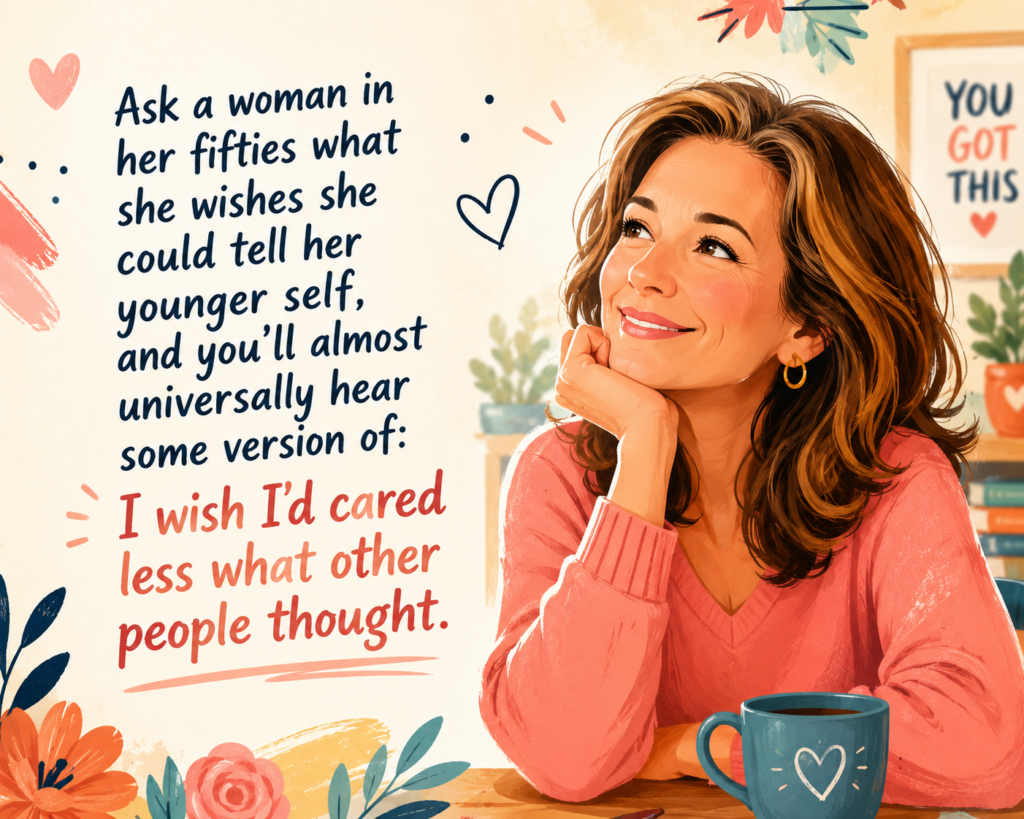
Ask a woman in her fifties what she wishes she could tell her younger self, and you’ll almost universally hear some version of: I wish I’d cared less what other people thought.
That shift — from seeking external approval to trusting your own sense of what’s right — is one of the most profound gifts of midlife.
Most women describe a growing ability to set boundaries without guilt, to say no without extensive explanation, to lead with their own values rather than others’ expectations. This isn’t a side effect of aging. It’s wisdom in action.
There’s a specific kind of joy that comes from this stage: the joy of knowing yourself deeply, of finally trusting your own perspective, of not needing to prove anything to anyone.

Reclaiming Your Body With Compassion
Your body in midlife is not broken. It is changing. Those are very different things.
The symptoms of perimenopause and menopause — disrupted sleep, shifts in energy, changes in mood and focus — are real and can be significant. And yet they are also manageable, especially with proper healthcare support. Too many women have been told to “just wait it out” or have been dismissed when they sought help. That’s not acceptable.
You deserve healthcare providers who take your symptoms seriously, who offer evidence-based options, and who treat midlife women’s bodies with the same attention and urgency given to any other health stage.
At the same time: your body at this age carries a lifetime of capability. It has survived, adapted, and carried you here. It deserves your compassion, not your contempt.
Community as Medicine
One of the most powerful things you can do in midlife — proven by research on longevity and mental health — is invest in your community.
Social connection is not a soft want. It’s a hard need. Women who feel connected, who have people they can be honest with, who are seen and known — live longer, healthier, happier lives.
The research on this is some of the most powerful in all of medicine:
- Women who were more socially integrated at around age 60 had a 10% longer lifespan and 41% higher odds of surviving to age 85 compared to women who were socially isolated. That’s not a small effect. That’s life-changing. → Harvard T.H. Chan School of Public Health: “Wider social network may help women live longer”
- Dr. Robert Waldinger, director of the 85-year Harvard Study of Adult Development — the longest-running study of adult life ever conducted — concluded: “Strong social relationships are the most consistent predictor of a long life.” Not genetics. Not diet. Relationships. → Harvard Gazette: “Over nearly 80 years, Harvard study has been showing how to live a healthy and happy life”
- Social connection directly reduces rates of depression, lowers chronic inflammation, and decreases blood pressure — three of the most significant health risk factors for midlife women. → Harvard Health: “Even a little socializing is linked to longevity”
This is what GalPal is built on. The idea that women sharing their real experiences, their fears and their wins, is itself a form of healthcare. That a community of women who understand each other is a source of hope and resilience that no supplement can replicate.
Join the conversation. Share what’s true for you. Find the women who get it.
Hope Is Not Naive — It’s Evidence-Based
We want to close with this: hope for midlife is not wishful thinking. It is backed by science, by stories, by the lived experience of countless women who’ve come out the other side of this stage with a fuller, freer, more fulfilling version of their lives.
Midlife is not the beginning of the end. For most women, it’s the beginning of something they didn’t know to hope for.
The research supports it. The evidence is there. The women who’ve lived it will tell you.
This is your power decade. And it’s just getting started.
Ready to connect with women who get it? Join the GalPal community and share your story. You don’t have to navigate midlife alone.