
College Drop Off Coping Tips :What No One Tells You
I’m writing this one in real time. I am not on the other side of this looking back — I am currently in the thick of packing up my youngest to head to college. If you’re a few weeks out from loading up the car, hugging your kid goodbye in a dorm parking lot, and driving home to a noticeably quieter house, I want you to have what I wish someone had handed me: the honest version of this, not the Pinterest version. I am sharing the unspoken truths about college drop off and tips and coping strategies backed by science.
Here’s the part of my story that might sound familiar: my son never soiled the nest. No slammed doors, no “I can’t wait to get out of this house,” no rebellious teenage years I was secretly counting down through.
Key Takeaways
- Parents face unexpected grief during college drop-offs, often struggling despite loving relationships with their kids.
- Experts highlight that both pride and sadness coexist during this transition; it’s essential to allow yourself to feel these emotions.
- Use practical tips to cope ahead: name your feelings, communicate with your child about their needs, and set expectations ahead of time.
- Rebuild your routine post-drop-off, connect with other parents, and help your child develop their own independence.
- Recognize signs of deeper sadness and seek support if necessary; it’s normal for both parents and kids to feel homesick.
We genuinely love spending every minute together. And that has made this so much harder than I expected, because there’s no built-in silver lining, no “well, at least we could use the break.” I just love them and I am losing the daily version of them, and that grief is real even though — especially because — nothing about our relationship needed fixing.
Everyone will tell you to bring extra hangers and a shower caddy. Almost no one tells you what actually happens to you on that drive home. So let’s talk about both — what nobody prepares you for, and what actually helps, according to people who study this for a living.

Spoiler: It Doesn’t Get Easier the Second Time Around
Here’s something nobody warned me about: this is not my first rodeo. I did this exact gut-punch of a drop-off with my oldest, Jake, and if you’re hoping the “you’ll be a pro this time” theory is true — I regret to inform you it’s a myth on the level of a mermaid, or a dentist appointment that’s actually fun.
I’ll tell you exactly how well I handled it the first time, because I think you deserve the unedited version: I made it all the way home, walked straight into Jake’s empty room, and lay down in his bed for about three hours, sobbing the kind of ugly-cry that requires a chaser of ice water and a nap afterward.
My Person Story
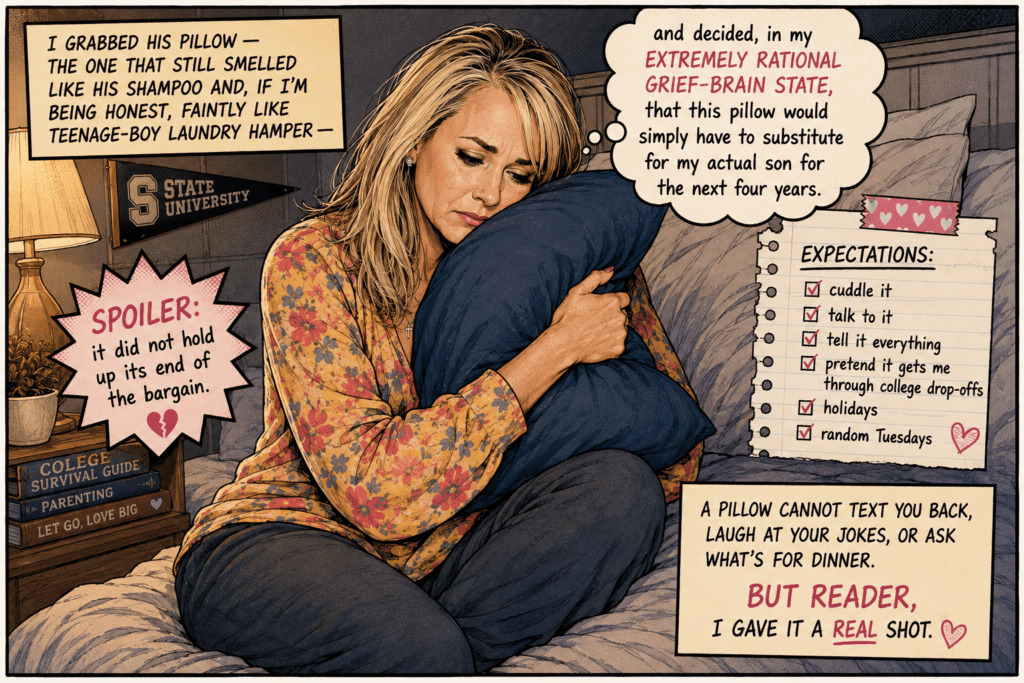
At some point I grabbed his pillow — the one that still smelled like his shampoo and, if I’m being honest, faintly like teenage-boy laundry hamper — and decided, in my extremely rational grief-brain state, that this pillow would simply have to substitute for my actual son for the next four years. Spoiler: it did not hold up its end of the bargain. A pillow cannot text you back, laugh at your jokes, or ask what’s for dinner. But reader, I gave it a real shot.
So when I tell you it doesn’t matter whether this is your first goodbye or your last, your oldest or your baby — I mean it from experience. I fully expected round two to be easier because “I’ve done this before.”
I have never been more wrong about anything, including the time I was certain I could assemble a dresser without the instructions. Love, it turns out, does not get less intense with practice. It just gets a little more familiar, which is its own strange, small comfort — right up until you’re back in a dorm parking lot, ugly-crying into someone’s shoulder again.
What No One Tells You About Drop-Off Day
Here’s the stuff that doesn’t make it into the packing lists:
a. You will probably cry at the worst possible moment!
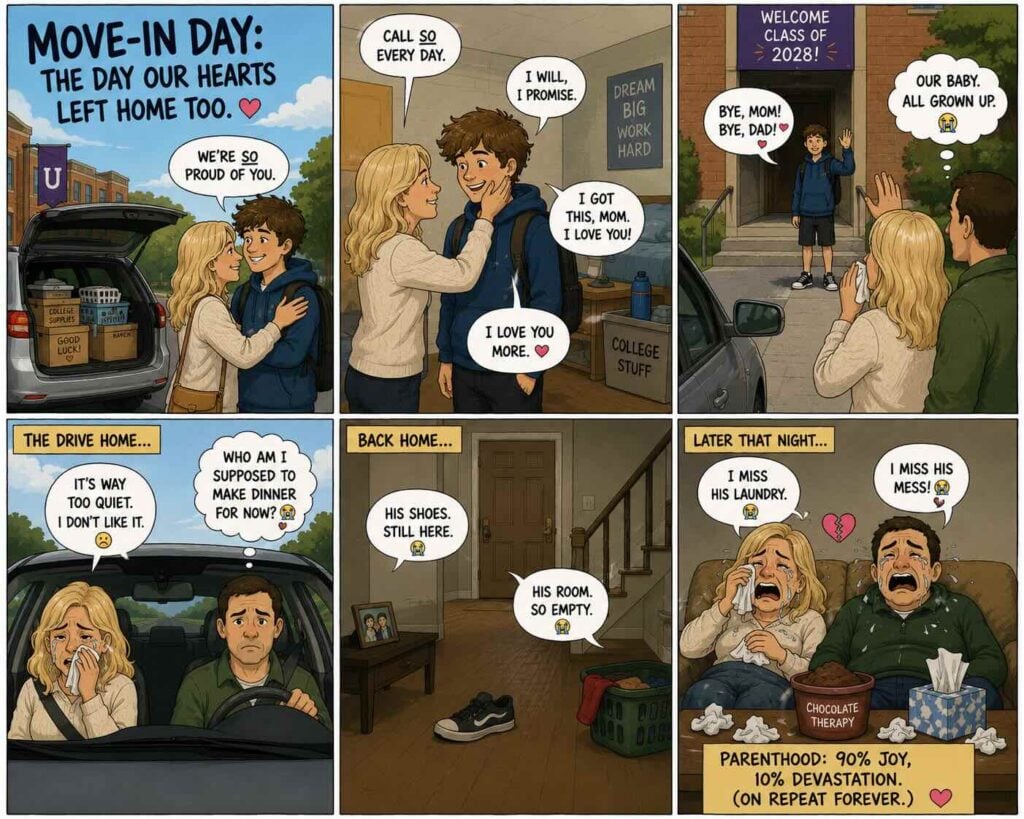
not during the tearful goodbye you rehearsed, but later, alone, over something small like folding an empty laundry basket or seeing their old shoes by the door.
b. Your kid may seem completely fine, even eager for you to leave.
That’s not rejection. Psychologist Karen Smith of Rutgers–Newark describes stress as being about “perceiving a potential threat or challenge, often characterized by high levels of unpredictability” — and for your child, this is the exciting kind of unpredictable. For you, it’s the scary kind. You’re both having valid, opposite reactions to the same moment.
c. Grief and pride can hit you in the same five minutes
It doesn’t end when you drive away. For many families, the hardest moment isn’t the hug goodbye — it’s walking back into the house that night.
d. Your partner (if you have one) may grieve completely differently than you do
We grieve differently and on a different timeline, which can strain the relationship right when you need each other most. Nothing tests a marriage quite like one of you sobbing in the shower while the other is calmly reorganizing the garage as if nothing happened.
e. You may find yourself talking to inanimate objects
A pillow, a poster, the family dog — no judgment here, I speak from deep personal experience (see: the Jake’s-pillow incident above). It’s weird, it’s normal, and it will pass.
You may feel guilty for being sad, especially if this was always the plan and your kid is thriving. You’re allowed to be genuinely happy for them and genuinely sad for yourself. Both are true.
f. The “empty nest” feeling can actually start before they even leave
In the last few weeks of summer, you both start pulling away in small ways. It’s a real, documented phenomenon, not just you being oversensitive.
If your kid was easy, this can hit even harder. No one warns you that a good relationship makes goodbye more painful, not less. If there was no friction to be relieved by, no attitude to be “done with.” You don’t get that little push of relief other parents describe. You just get the loss, straight up.

If You’re Devastated, That Might Be the Best Sign of All
I need to say this to you the way I need to hear it myself: if you are absolutely wrecked over this goodbye, that is not a sign you’re struggling to cope. That is a sign you did the job well.
Think about what it actually means to be this sad.
It means you built a home your kid didn’t need to escape from. It means the daily rhythm of them being around — the noise, the mess, the inside jokes — was something you genuinely loved, not something you were enduring.
Parents who are devastated at drop-off are, more often than not, the parents whose kids know, without a doubt, that they are loved.
That certainty is the whole point. It’s the thing you spent eighteen years building, and it’s showing up right now as grief, because that’s what love does when it has to stretch across a few hundred miles.
Tip: Give yourself some grace here. And honestly, give yourself some credit too. This isn’t a parenting failure playing out in real time — it’s the receipt for everything you did right. Let it hurt. It’s supposed to, because it mattered.

Why It Hits So Hard — According to the Experts
This isn’t just “in your head,” and it isn’t a personal failing. Researchers who study family transitions have a lot to say about why this particular goodbye is so uniquely hard.
Communication researcher Dawn O. Braithwaite, Ph.D., Professor Emerita at the University of Nebraska-Lincoln, has written extensively on the family shift that happens during this transition. Research she cites from Mount and Moas (2015).
“Parents that may feel anxious and depressed and question who they are as they navigate relationship changes” — because a huge part of your identity has been organized around this daily act of caregiving, and that structure is changing overnight.
Dawn O. Braithwaite, Ph.D.
“This is a huge transition that can be filled with distress, loss, nostalgia. Let yourself feel it.” That’s the whole thesis, really — the goal isn’t to avoid the feelings, it’s to let them move through you instead of getting stuck.
Psychiatrist Eugene Beresin
Over at Rutgers, Stephanie Marcello, Assistant Vice President of Academics, Integration and Innovation with the Behavioral Research and Training Institute, puts it simply: “This is a huge transition that can be filled with distress, loss, nostalgia. Let yourself feel it.” That’s the whole thesis, really — the goal isn’t to avoid the feelings, it’s to let them move through you instead of getting stuck.
And it’s not just you. The JED Foundation, a leading nonprofit focused on teen and young adult mental health, reports that roughly 94% of college students experience homesickness within their first 10 weeks on campus. Your kid is likely white-knuckling their own version of this, even if their texts home say “it’s fine mom.”

Tips for Parents
Experts consistently point to a few strategies that make a real difference. Here’s what to actually do with all these feelings:
Cope Ahead
Process some of the grief before drop-off day rather than saving it all for the parking lot. Cry in the weeks leading up to it, talk it through with a friend, let yourself feel the loss in pieces so it doesn’t all land at once.
Name it out loud instead of stuffing it down. Marcello’s advice bears repeating — let yourself feel it. Suppressed grief tends to leak out sideways, often as irritability or anxiety directed at the people around you.
Watch For Projection
It’s tempting to call your kid five times in the first week “just to check in,” but that can transfer your anxiety onto them right when they need to build confidence in handling things solo. Rutgers psychologists specifically recommend catching yourself before this happens.
Rebuild your own routine, on purpose
Reconnect with a hobby, a friend group, or an interest you shelved during the intensive parenting years — yes, even that yoga mat that’s been serving as a laundry surface since roughly 2021. This isn’t a distraction — it’s genuinely part of how you reconstruct your identity outside the caregiver role.
Set communication expectations together, before you leave campus.
Agree on something concrete — a weekly Sunday call, a standing text check-in — so you’re not guessing or waiting anxiously for a message that doesn’t come.
Find Your People
Talking to other parents who are going through this at the exact same time is one of the most consistently recommended coping tools. You do not have to explain the empty-nest ache to someone still in the thick of school pickup lines — but another freshman parent gets it instantly, usually via a group text that’s 90% crying-laughing emojis and 10% actual words.
Give Yourself Permission To Grieve & Celebrate
These aren’t contradictory. Try to let the grieving happen on its own timeline, separate from the moments meant for pride and celebration, so one doesn’t swallow the other.
Know When It’s More Than Normal Sadness
As pediatrician Dr. Natalie Jedacek of Akron Children’s puts it, “Every parent has some level of anxiety when their child goes off to college. However, if it starts affecting their daily lives, they are constantly calling, having trouble focusing or crying all the time, these are signs it’s time to contact a professional for help.” There’s no shame in that — this is a genuine life transition, and support exists for a reason.

Tips for Your Student
You can’t do this part for them, but you can set them up well before you drive away:
- Encourage them to make a “keep in touch” plan before they even feel homesick. Experts note that deciding on a communication rhythm in advance — rather than waiting until the loneliness hits — prevents the panic-text spiral later.
- Suggest they bring a few grounding objects from home — photos, a blanket, something familiar for the dorm room. Small physical anchors genuinely help with the disorientation of a new environment.
- Push them toward campus community early, not after they’re already lonely. Clubs, floor events, involvement fairs — the first two weeks matter disproportionately for building the friendships that get them through October.
- Let them own their own healthcare logistics before they need to. Dr. Jedacek suggests, “If possible, let your child see doctors alone a few times before they head off to college to give them the confidence to manage it on their own.” If you can practice this over the summer, do.
- Normalize the low points in advance. Tell them plainly: most students feel homesick, it’s not a sign something’s wrong, and it usually eases within the first couple of months. Knowing that in advance makes the wave much less scary when it hits.
- Coach, don’t rescue. This is the single biggest mental shift experts recommend for parents in this new phase — moving from “fixing it for them” to “helping them think it through.” It’s a hard habit to break, and it’s the whole point of what comes next for both of you.
Conversations to Have When Your Student Gets Homesick
Somewhere around week three or four — right on schedule with that 94% homesickness statistic — you’re probably going to get “the call.” You’ll know it the second you pick up: the shaky voice, the “I don’t know if I can do this,” the pause that lasts a beat too long. Here’s how to handle that conversation without panicking, driving up on a rescue mission, or accidentally making it worse.
Lead with validation, not solutions
“That sounds really hard. I’m so glad you called me.” Skip the instinct to jump straight to “you’ll be fine, everyone feels like this” — it’s true, but in the moment it lands like you’re rushing them past the feeling instead of sitting in it with them.
Ask open-ended questions instead of leading ones
“What’s making today feel hard?” invites an actual answer. A rapid-fire “Are you eating? Are you sleeping? Did something happen?” can feel like an interrogation, even when it comes from love.
Tell Them How Normal It All Is
Share your own homesick story — briefly, then hand the mic back. A quick “I remember calling my mom crying during my first month too” normalizes what they’re feeling without turning the call into your memoir.
Watch the guilt trip, even the well-meaning kind. Save “we miss you so much, the house feels so empty” for a good day. Said in the middle of their hardest moment, it can quietly add “and now I feel bad for making you sad” on top of everything else they’re carrying.
Give Them One Small Next Step
Give them one small, doable next step, not just reassurance. Vague comfort rarely moves someone out of a funk — a concrete micro-action does. Suggest grabbing coffee with someone on their floor, checking out one club meeting this week, or just walking to the dining hall instead of ordering delivery again.
Agree On The Next Check In Call
Set the next check-in before you hang up. “Let’s talk again Thursday” gives you both something to hold onto instead of an open-ended worry loop. Nobody needs to schedule calls like a hostage negotiation, but a specific day genuinely helps.
Identify Worrisome Symptoms
Know when homesick becomes something more. Watch for skipped meals or classes, sleep that’s fallen apart, talk of hopelessness, or a sadness that isn’t easing after the first couple of months. That’s the moment to gently suggest — together — a visit to the campus counseling center, not just “push through it” advice.
Resist The Urge To Rescue Them
As hard as it is, showing up to rescue them can quietly undercut the independence they’re building, unless there’s a genuine safety concern. Your job right now is to help them find their own footing, even when every instinct says to fix it for them.
A Simple Script for the Actual Goodbye
If you want something concrete to hold onto in that parking lot, keep it short, warm, and forward-looking rather than drawn out.
Something like: “I am so proud of you. I’m going to miss you like crazy, and that’s okay — it just means we built something good. Call me Sunday. Go live your life.”
Then let it be quick. Long goodbyes tend to make the moment harder for both of you, not easier.
And if the words won’t come out because you’re too busy trying not to full-on ugly-cry in front of the RA, a shorter backup works fine too: “Love you. Don’t drink the tap water. Bye.” Nobody said it had to be poetic.
The Bottom Line
Nobody really prepares you for this one. It’s grief and pride tangled together, and both are allowed to be true at the same time. Cope ahead where you can, let yourself feel what comes anyway, lean on people who are living the same season, and trust that you spent eighteen years preparing them for exactly this moment — even when it doesn’t feel like enough.
To the parents like me, standing in a dorm parking lot loving your kid so much it physically hurts to leave: this heartbreak is not a red flag. It’s proof of something you built well. Give yourself the grace to fall apart a little, and the credit for knowing exactly why you’re falling apart. Your kid is walking into their next chapter secure in your love, and that security came from you.
And if you happen to find yourself hugging a pillow that smells like them for old times’ sake — I regret to inform you this remains a completely valid coping strategy, no age limit attached. Ask me how I know.
You’re going to be okay. So are they.
Frequently Asked Questions
How long does empty nest sadness typically last?
For most parents, the acute grief and loss around drop-off eases within one to two months as new routines settle in, according to psychologists at Rutgers Behavioral Health Care.
Is it normal for my child not to seem sad about leaving?
Yes. Kids often process this transition with excitement rather than grief, which can look like relief. That’s a normal, healthy sign of readiness — not a lack of love.
How often should I contact my college freshman?
Experts recommend agreeing on a specific, consistent cadence (like a weekly call) before drop-off, rather than reaching out reactively based on your own anxiety in the moment.
What percentage of college freshmen get homesick?
Research cited by the JED Foundation indicates roughly 94% of college students experience homesickness within their first ten weeks on campus.
Why am I so devastated when my child leaving for college was never a bad thing?
A strong, easy relationship removes the usual “relief valve” of drop-off — there’s no friction to be glad to see the back of. Being wrecked by a good goodbye is a healthy response to real love, not a sign of struggling to cope.
Does it get easier by the second or third kid?
Not really, and it’s fair to plan for that instead of being blindsided by it. Each child’s departure carries its own grief, even once you’ve technically “done this before.” What does change is that you’ll recognize the wave faster and know it will pass — which buys you a little more self-compassion, and possibly a spare pillow.
Sources: Psychology Today (Dawn O. Braithwaite, Ph.D., citing Miller & Servaty-Seib, 2016; Mount & Moas, 2015; Beresin, 2025); Rutgers Health (Stephanie Marcello; Karen Smith, Ph.D.); Akron Children’s Hospital (Dr. Natalie Jedacek); The JED Foundation; CampusCareMD.